
Walking the Sky-High Pass of Haneuljae in Chungcheongbuk-do Chungju City · schedule Other · distance 15.4km · 3 stops · highlights Chungju Mireuk Daewon…
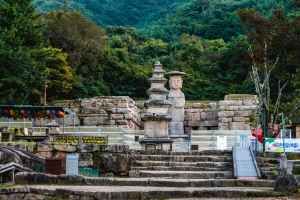
Haneuljae is the first road ever opened in Korea. It was crossed by Crown Prince Maui to soothe the sorrow of a fallen kingdom and by King Gongmin to escape the Huangjin Rebellion. After the opening of Mungyeong Saejae, it became a quiet old path, but the 2.5km trail from Mireukri Temple Site to Haneuljae is an endlessly serene and beautiful forest path.
This course is a sample one-day itinerary. Save it as-is or expand it into an AI itinerary.
The Mireuk Temple site is spread southward in the basin between the Haneuljae mountain pass connecting Chungbuk and Gyeongbuk. The Mireukri temple site (彌勒里寺址) is said to have been established by the last prince of Silla, Ma-ui Taesa, who, while on his way to Geumgangsan, received a dream revelation from Avalokitesvara Bosal to erect a stone Buddha statue. Upon crossing Haneuljae and confirming the geographical conditions, he erected the statue and built the temple at present-day Mireuk-ri. The second excavation by Cheongju University from 1977 to 1978 revealed the temple's name as Mireukdaewonsa, and the third excavation by Ewha Womans University in 1980 found that a stone grotto temple was once operated here but was destroyed, leaving only the stone structures. According to the Samguk Sagi, Silla Annals, in the third year of Adallaiisageum (156), "In April, the Gyellipryeong path was opened." This marks Silla’s exchanges with Baekje and Goguryeo and eventually achieving the unification of the Three Kingdoms via the Han River. The Mireuk Temple site is a rectangular temple site of about 14,000 pyeong with a single pagoda and a single golden hall arranged. Within Mireukri site stand a five-story stone pagoda (treasure) and a standing stone Buddha (treasure), along with a stone lantern and a three-story stone pagoda designated as local tangible cultural heritage. The Jungwon Mireukri site is a unique grotto temple combining stone and wooden structures, oriented northward with a stone grotto serving as the main hall. Further, the stone Buddha at Mireuk Temple is the only north-facing statue in the country. The square grotto main chamber housing the statue measures 9.8m wide by 10.75m deep, with stone walls 6m high built of large Musaseok stones, enshrining the statue at its center. Above the stone walls stood a now-disappeared wooden building, and the front hall was a half-underground wooden grotto structure.
There is a small trail just past the Mireuk-ri three-story stone pagoda in Wolaksan. Facing a picturesque view of faraway hwangjangmok (red pine), oak trees, and haesong (Korean red pine), this path, known as 'Haneuljae,' opens to a cool breeze under the clear sky. The ditch lower to the left side of the path may sometimes dry up due to drought, but wildflowers like bright pink balsam, deep purple water artemisia, and yellow jipsinnamul greet travelers along with the rocky cliffs and peaks nearby. Although the name suggests it touches the sky, Haneuljae (elevation 525m) is not very high. It serves as the provincial boundary connecting Mireuk-ri, Suanbo-myeon, Chungju-si, Chungcheongbuk-do with Gwan-eum-ri, Mungyeong-eup, Mungyeong-si, Gyeongbuk. About 30-40 minutes (2 km) from Mireuk-ri leads directly to Gwan-eum-ri in Mungyeong. The rough dirt road smooths into an asphalt path at the Haneuljae pass's ridge, where the summit of Daemisan Mountain (elevation 1,115m) in Mungyeong appears faintly to the west. Below Haneuljae lies the site of Jungwon Mireuk-ri Temple, believed to have been established from the late Silla to early Goryeo periods, with remnants like dangganji-ju (flagpole supports) and corridors indicating a large scale. It is the only Buddhist temple in Korea oriented north and located in Mireuk-ri basin between Jilpjae and Haneuljae. The wooden structures of Jungwon Mireuk-ri Temple were destroyed during the 13th-century Mongol invasions. Remaining are a five-story stone pagoda (treasured), stone Buddha statue (treasured), stone lantern (provincial tangible cultural asset), and three-story stone pagoda (provincial cultural asset). Excavations by Cheongju University Museum in 1977 and 1979 revealed it as 'Mireukdaewon,' where the monk Il-yeon once resided. Close proximity to Wolaksan National Park, the Mireuk-ri original site, and Haneuljae's historical and nature observation trail attracts many tourists.
The Suanbo Oncheon Tourist Special Zone is a traditional hot spring resort. It is known as Korea's first naturally flowing hot spring, said to have existed for 30,000 years, and its benefits are well recognized. The hot spring water, flowing from 250 meters underground, is mildly alkaline. Managed directly by Chungju City, the hot spring water contains beneficial far-infrared radiation and various minerals. Because of this, Suanbo Oncheon has attracted many visitors seeking treatment and relaxation since ancient times. At the center of Suanbo Oncheon is Muldang Park, where a shallow stream of hot spring water flows. Most travelers use accommodations such as hotels and motels within the Suanbo Oncheon area to enjoy the hot spring baths. Nearby, there are many natural attractions to explore, including Wolaksan Mountain, Chungju Lake, and Songgye Valley.
Good places to stop and rest after the course

Booking and payment continue on a partner site.
Check rooms & price
Booking and payment continue on a partner site.
Check rooms & priceSign up to feature your channel.
(As a member, you can add your Instagram, YouTube, and blog links in My Page, and we’ll show them with every comment you write.)
““Stayed near Hongdae and did a night café tour. Perfect city views and vibes.””
Guest comments do not display social media links or profile cards.
Share a short tip about this place.
Or leave a quick comment as a guest.
Photo attachments are available after login.
No reviews yet. Be the first to share your experience!


