
In the Nature of Cheongsong Centered on Juwangsan in Gyeongsangbuk-do Cheongsong County · schedule Other · distance 23.6km · 5 stops · highlights Juwang…
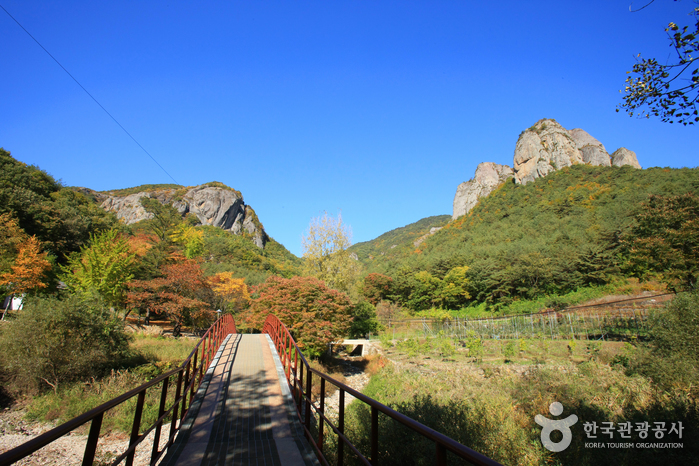
Walking the mountain ridges of Juwangsan, which form the backbone of Baekdudaegan, is undoubtedly a healing method. The deep and exquisite scenery represents Korea well. Also, to see the formation process of Cheongsong, the Folklore Museum cannot be missed. You will be deeply immersed in the charm of Jungpyeong Pine Forest, hidden sparsely in the striking mountain terrain, and Sayangseowon.
This course is a sample one-day itinerary. Save it as-is or expand it into an AI itinerary.
Juwangsan (720.6m) is located on a branch of the Taebaek mountain range, which forms the backbone of the Baekdudaegan mountain system in the Korean Peninsula. It is one of Korea's three major rocky mountains, known for its numerous rocky peaks and deep, picturesque valleys. Designated as a tourist attraction on May 30, 1972, it became the 12th national park on March 30, 1976. The park covers a total area of 105.582 km², spanning five myeon in two counties, Cheongsong-gun and Yeongdeok-gun. To the north lie Seoraksan and Odaesan National Parks, and to the south Gyeongju, while to the west are the national parks of Songnisan and Deogyusan. Peaks include Taehangsan, Dusuram, and Gamebong, and valleys such as Jubang, Jeolgol, and Wolae are scattered throughout. With hundred-meter-high rocks standing like a folding screen, it was called Seokbyeongsan in the Silla period and renamed Juwangsan from the late Unified Silla period. Besides four waterfalls, Juwangsan has caves, Daejeonsa Temple, and its associated hermitages, making it a place rich in natural tourist resources.
1999년도에 건립된 1종 전문박물관이다. 이 박물관은 청송의 민속문화를 조사·연구·보존·전시함으로써 향토문화의 형성과정의 고찰과 함께 국민의 사회교육의 장과 휴식공간으로 제공되어 올바른 지방문화의 이해를 돕고 있다.
Song-i Garden is a specialty restaurant featuring eco-friendly dishes with song-i (pine mushrooms) as the main ingredient, including song-i mushroom hot pot and native clear chicken stew. You can enjoy healthy food carefully made with fresh local food produced in this area. The representative menu, mushroom hot pot, includes various mushrooms along with song-i mushrooms and has a mild and light broth that anyone can enjoy regardless of age or gender. The side dishes served alongside use healthy ingredients from local agricultural products, such as mountain vegetables and acorn jelly.
Jungpyeong Pine Forest is a pine forest of about 3,000 pyeong located at the entrance of Jungpyeong-ri, Pacheon-myeon, Cheongsong, featuring over 80 pine trees over 200 years old forming a dense forest. It is a typical biborim (protective forest) that prevents the beneficial energy of the village from leaking outside and has a significant aesthetic function to prevent outsiders from recklessly looking into the village. Inside the forest, it provides a comfortable resting place for villagers and travelers. Jungpyeong Pine Forest has well-maintained grounds and is near Yongjeoncheon stream, equipped with camping facilities such as decks for tents and showers, making it an ideal place for light summer vacations with family while fishing. The village is known as Jungpyeong Seonbi Village in Cheongsong, an international slow city, where visitors can experience the atmosphere of hanok and the spirit of old scholars, as well as tour Pyeongsan Shinssi Pansagongpa ancestral house, Seobyeok Old House, and Sanam Old House, all designated National Folk Cultural Properties in 2014.
Sayang Seowon, located at the foot of Pilbong in Jungpyeong-ri, Pacheon-myeon, Cheongsong, enshrines Munjeonggong Shin Hyeon, the 12th generation descendant of Shin Sung-gyeom, a founding meritorious subject of Goryeo, as the main figure, and his son Munhwangong and late Goryeo scholar Unkok Won Cheonseok as the east and west ancestral tablets. Scholars who honored Munjeonggong Shin Hyeon built Hwahaesa Temple under Gyeryongsan Mountain in Chungnam in 1932 and enshrined his memorial tablet there. Due to Unkok editing the biography of Shin Hyeon called Hwahaesajeon, they were enshrined together. Later, when the seowon’s land was redistributed during land reform, it was relocated to its current site and named Sayang Seowon, keeping the commemorative plaque intact. The Hwahaesa plaque is said to have been written by Baekbeom Kim Gu. Shin Hyeon passed the state exam during King Chungsuk’s reign in Goryeo and studied with scholars in Yuan, further dedicating himself to scholarship and becoming a great scholar. Unkok Won Cheonseok taught Crown Prince Bangwon of Joseon Taejong and was repeatedly invited to serve by Taejong, but he refused out of loyalty to Goryeo and lived in seclusion. At the village entrance, a pine forest of about 3,000 pyeong with around 80 two-hundred-year-old pine trees forms a dense forest.
Good places to stop and rest after the course

Booking and payment continue on a partner site.
Check rooms & price
Booking and payment continue on a partner site.
Check rooms & priceSign up to feature your channel.
(As a member, you can add your Instagram, YouTube, and blog links in My Page, and we’ll show them with every comment you write.)
““Stayed near Hongdae and did a night café tour. Perfect city views and vibes.””
Guest comments do not display social media links or profile cards.
Share a short tip about this place.
Or leave a quick comment as a guest.
Photo attachments are available after login.
No reviews yet. Be the first to share your experience!


