Seeing Songsogotaek and Jusanji in Cheongsong in Gyeongsangbuk-do Cheongsong County · schedule Other · distance 43.8km · 5 stops · highlights 야송 미술관, 점심…

Songsogotaek, a major historic site in Cheongsong, Gyeongbuk, is a large traditional noble house with 7 buildings and 99 rooms. Known as the Sambuja residence, this house is famous as a cultural property that perfectly preserves the traditional yangban (aristocratic) house. The Yasong Art Museum and the dragon-shaped rock nearby, as well as the widely known Jusanji Pond, are also attractions in Cheongsong.
This course is a sample one-day itinerary. Save it as-is or expand it into an AI itinerary.
청송야송미술관은 지역출신 한국화가로 대한민국미술대전 심사위원을 지낸 한국화가 야송(野松) 이원좌(李元佐) 화백이 소장하고 있던 한국화 및 도예작품 등 350점, 국내외 유명 화가와 조각가들의 작품 50여 점, 미술관련 서적 1만여 점을 기증받아 舊 신촌초등학교를 현대식 미술관으로 단장하고 2005년 4월 29일 개관하였다.
만바우촌은 이 천혜의 약수자원과 더불어 큰 바위 병풍으로 비유되는 단애의 절경을 옆으로 하며, 2천여 평의 푸른 정원 숲 속에 조용하고 편안한 휴식공간을 제공해주고 있다. 특히, 정원 숲 한곳에 마련된 족구장은 만바우촌을 찾는 모든 고객의 체육 공간으로 활용되고 있다.
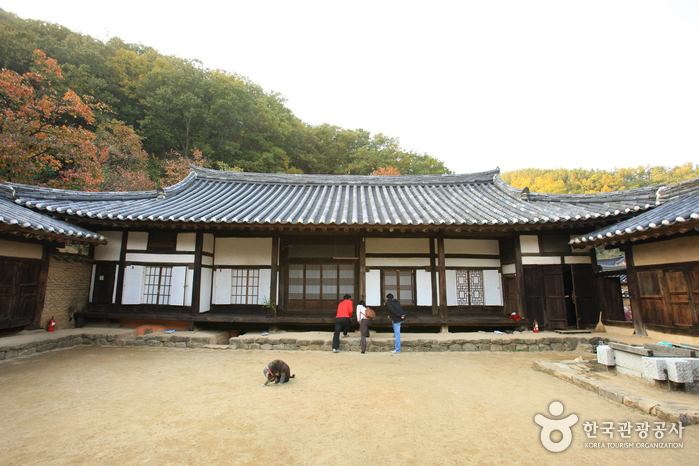
Songsogotaek in Deokcheon Village, Cheongsong, was a mansion of a wealthy landowner with 99 rooms during the Joseon Dynasty. In 1880, Songso Sim Hotak, the 7th descendant of Sim Cheodae who enjoyed great wealth during King Yeongjo's reign, moved from Jigyung-ri (Hobakgol), Pacheon-myeon, back to their ancestral home in Deokcheon-ri and built this house to reside there, placing a signboard reading “Songso Sejang.” The building features Northern Gyeongbuk folk house style, including a separate courtyard and distinct areas for living, work, and reception, preserving upper-class Joseon Dynasty residential characteristics well. Also notable are the inner and outer walls dividing the outer yard, and a special shrine (byeolmyeo) for ancestral rites spanning up to four generations under the extended family system, representing high ethnological value. A traditional house experience program offers a stay in this tranquil hanok with beautiful natural surroundings. Since it is a private residence where the current owner lives, entry or stepping onto the floor is prohibited during general visits. (Please note some parts of the building were damaged by a wildfire in March 2025.)
Hyeonbiam is a cliff about 20 meters high located along Yongjeoncheon in the center of Cheongsong-eup. The bizarre cliff and trees are reflected in Yongjeoncheon, creating a strange and beautiful landscape. The name Hyeonbiam comes from the fact that the ancestral tomb of the Cheongsong Sim clan is on the Bogoangsan mountain behind this rock, and it is said that a virtuous queen like Queen Sohyeon of King Sejong the Great was born there. According to legend, a dragon that could not ascend to heaven fell at Hyeonbiam. One early morning, a woman who went to the stream to do laundry saw the ascending dragon and screamed in surprise. The dragon, which had dreamed of ascending for thousands of years, fell at that spot and turned into a rock. The stream flowing under the rock is said to be the tears of the dragon, filled with regret for not ascending. Since this rock looks like a dragon's head from afar, it is also called Yongbiam. Along Yongjeoncheon by Hyeonbiam, there is a wide sandy beach comparable to a seaside beach, and the Hyeonbiam Riverside Bathing Resort has been established.
Jusanchi is a reservoir that began construction in August 1720, the first year of King Gyeongjong of the Joseon Dynasty, and was completed in October the following year. On the rock at the entrance of Jusanchi, there is a memorial stele honoring Lee Jinpyo, a descendant of Wolsung Lee from the 47th year of King Yeongjo (1771), and Jose Man, who made great contributions to the Jusanchi embankment. Since its completion, the reservoir has never dried up or exposed its bottom, even during long droughts. This is due to the geological characteristics of the land holding the water. Jusanchi was created on a rock called welded tuff, which is formed by volcanic ash cemented together; this rock contains dense minerals that make water passage difficult. Particularly, about 30 old willow trees and large willows grow naturally in the lake, creating a beautiful landscape harmonized with the lake. The large willows appear to float on the water, evoking a tranquil and cozy atmosphere as if arriving in a magical world, making it a perfect place to forget the mundane world and relax for a while. Combining rock, water, and trees, Jusanchi offers different scenery each season and was designated a nationally recognized cultural asset as a scenic site in 2013, reflecting its high natural heritage value.
Good places to stop and rest after the course

Booking and payment continue on a partner site.
Check rooms & priceSign up to feature your channel.
(As a member, you can add your Instagram, YouTube, and blog links in My Page, and we’ll show them with every comment you write.)
““Stayed near Hongdae and did a night café tour. Perfect city views and vibes.””
Guest comments do not display social media links or profile cards.
Share a short tip about this place.
Or leave a quick comment as a guest.
Photo attachments are available after login.
No reviews yet. Be the first to share your experience!