Busan autumn alive with film in Busan Jung-gu · schedule Other · distance 28km · 5 stops · highlights Busan Jagalchi Market, Haedong Yonggungsa Temple,…
When it comes to Busan, one cannot miss the 'Busan International Film Festival.' You don't necessarily have to watch a movie. During the festival period, the entire city is filled with a festive atmosphere, making everyone feel joyful just by being in Busan. At BIFF Square, where the pre-festival events take place, you might brush past stars, and if you're lucky, you may share a drink with celebrities at a sashimi restaurant in Jagalchi Market or Haeundae Beach. Isn't just thinking about it delightful?
This course is a sample one-day itinerary. Save it as-is or expand it into an AI itinerary.
Jagalchi Market is a coastal street spanning Nampo-dong and Chungmu-dong in Jung-gu, adjacent to the downtown area, serving both market and entertainment functions. Along with the nearby Shindonga Seafood Market and dried seafood market, it best represents the character of the Busan region. The name Jagalchi originates either from the gravelly coast or from a type of fish called 'jagalchi,' which is widely traded as live fish. Along the roadside by Jagalchi harbor, vendors—mostly older women—sell rare sights of mackerel, sea squirts, whale meat, and more. On the first floor of the Shindonga Seafood Market, which opened in 1980, fresh live fish are sold and delicious sashimi can be enjoyed on the spot. The second and third floors sell dried seafood and have raw fish restaurants, becoming a new attraction of Jagalchi Market. The market grew after 1889 when Japanese residents established the Busan Fisheries Joint-Stock Company nearby to protect their fishermen. As merchants gathered there, Jagalchi Market traders gradually sought modernization. By 1922, the Busan Fisheries Cooperative built a building in Nampo-dong and started a consignment sales business, gathering Jagalchi traders around a central hub. Subsequently, Busan's fish market divided into the northern Busan Fisheries Joint-Stock Company port and the southern Busan Fisheries Cooperative consignment sales market. Later, the Busan Fisheries Joint-Stock Company developed into today's Busan Cooperative Fish Market, the largest fish market in Korea, while small-scale fishermen’s catches were handled by small traders near the southern cooperative consignment sales market, forming the current Jagalchi Market.
Haedong Yonggungsa Temple was founded in 1376 by Naong Daesa, the royal teacher of King Gongmin, and is one of the Three Great Gwaneum Sacred Sites in Korea. It harmoniously combines the sea, dragons, and the Great Gwaneum Buddha, embodying deep religious meaning. It is famous as a place where anyone who sincerely prays will receive a divine dream and have one wish granted. Destroyed during the Japanese invasions of Korea, it was rebuilt in the early 1930s by Ungang of Tongdosa. In 1974, Monk Jeongam became the temple head, vowed to restore it as a Gwaneum site, and performed a 100-day prayer; after dreaming of Gwanseum Bosal dressed in white riding a dragon and ascending, he renamed the temple Haedong Yonggungsa. Existing buildings include the Daeungjeon, Gulbeopdang, Yongwangdang (Yonggungdan), Beomjonggak, and temple lodgings. The Gulbeopdang next to Daeungjeon, also called Mireukjeon, enshrines a seated Maitreya stone Buddha since its founding, known as Deuknambul, believed to grant offspring to those without descendants if they pray. In front of Daeungjeon stands a four-lion stone pagoda.
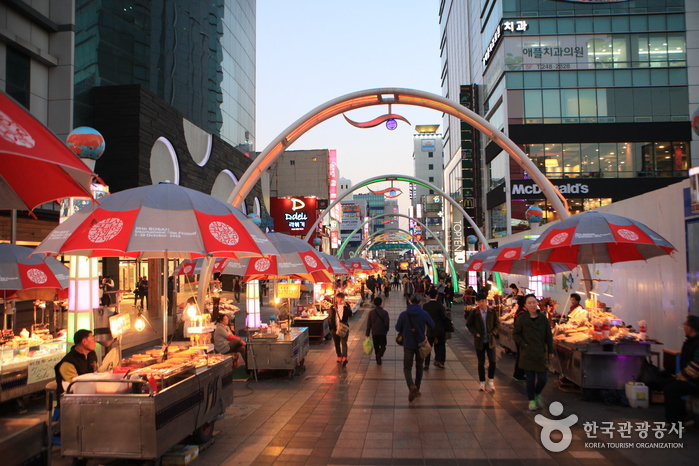
After the liberation on August 15, a few theaters appeared in the Nampodong theater district, and by the 1960s, around 20 theaters had clustered around BIFF Plaza. On September 13, 1996, the 1st Busan International Film Festival (BIFF) was held to create a small but prestigious film festival. Along with the festival, the theater district was renovated and named BIFF Plaza. BIFF Plaza hosted the BIFF opening eve events and major BIFF activities such as famous filmmakers' handprinting ceremonies. However, as the Busan Cinema Center was built in Haeundae, the main events moved there. Yet, many traces of the festival's early days remain, and film screenings continue. This concentration of premiere theaters in one place is unique not only in Asia but also in Europe and holds infinite potential. Recently, it has evolved into a complex cultural space offering shopping and tourism alongside films, attracting many young people and playing a major role in revitalizing the local commercial district.
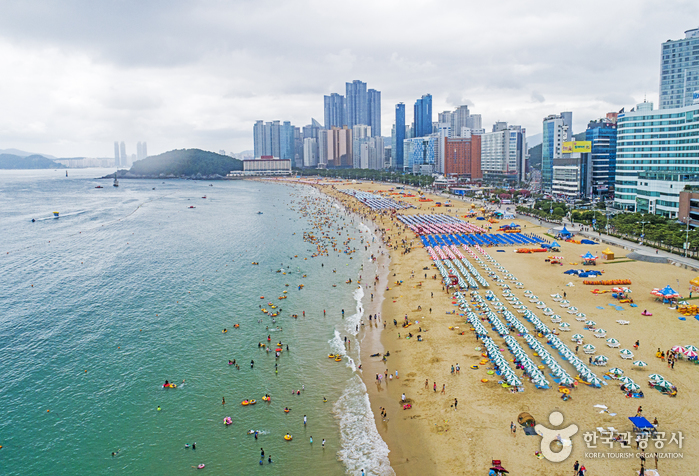
Haeundae Beach boasts a wide white sandy shore and beautiful coastline, offering ideal conditions for swimming with shallow waters and gentle waves. It is the most iconic spot representing Busan, often the first place that comes to mind when thinking of the city, and it attracts the largest crowds in the country, especially during the summer vacation season. The coastline is lined with large and small buildings and luxury hotels, giving the beach a modern and sophisticated atmosphere. It is bustling with youthful energy year-round, not only in summer, and is well-known among international tourists. Every year, the beach hosts a full moon festival on the first full moon day of the lunar new year. Additionally, the annual Polar Bear Swimming Contest held in winter has established itself as a representative winter festival. Other events include sand art exhibitions and the Busan Sea Festival. Nearby attractions around the beach include Dongbaekseom Island, Oryukdo, an aquarium, yacht races, and Bexco Dalmaji Hill. ◎ Travel information to experience the charm of Hallyu - The drama features scenes where Nam-soon and her Mongolian mother create the word 'sea' in shells on the sand and enjoy taking pictures together.
SEA LIFE Busan Aquarium is an aquarium operated by the SEA LIFE brand and is a tourist attraction in Busan with over 15 million cumulative visitors. SEA LIFE Busan operates a total of 8 exhibition halls, featuring various marine species, and presents vivid marine ecosystems through shark transparent boats and VR experience zones. It spans from basement level 1 to basement level 3, with tanks and an underwater tunnel designed by themed characteristics, offering comprehensive underwater ecosystem experiences. In 2014, the aquarium underwent internal renovations for rebranding to create a more friendly environment, adding new facilities such as the Ray Coast, Seahorse Kindergarten, and Shark Walk.
Good places to stop and rest after the course
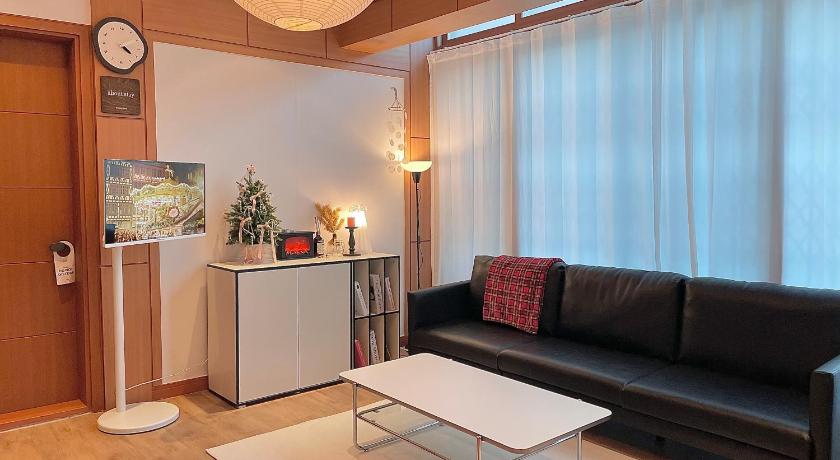
Booking and payment continue on a partner site.
Check rooms & priceSign up to feature your channel.
(As a member, you can add your Instagram, YouTube, and blog links in My Page, and we’ll show them with every comment you write.)
““Stayed near Hongdae and did a night café tour. Perfect city views and vibes.””
Guest comments do not display social media links or profile cards.
Share a short tip about this place.
Or leave a quick comment as a guest.
Photo attachments are available after login.
No reviews yet. Be the first to share your experience!