
Walking Toegye Path from Cheongnyangsan to Andong in Gyeongsangbuk-do Bonghwa County · schedule Other · distance 18.7km · 3 stops · highlights Cheongnya…
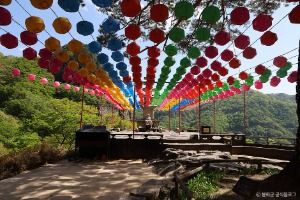
The purity and mysterious mountain terrain of Cheongryangsan go without saying. Take a stroll along the quaint Cheongryangsa Temple and the Toegye Path in Andong. This trail, winding along the Nakdong River's flow, is as radiant as ever. Walking along the river feels slow and cozy, like heading toward a warm hometown, bringing happiness.
This course is a sample one-day itinerary. Save it as-is or expand it into an AI itinerary.
Cheongnyangsa, located in Cheongnyangsan Provincial Park, is a temple founded by Monk Wonhyo in the 3rd year of King Munmu of Silla (663). At its founding, it was a large temple with 33 subsidiary buildings such as the seungdang. Cheongnyangsan, known for its beautiful natural scenery, has large and small hermitages including Yeondae and Mangseonam, ancient temples of Silla, forming a cradle of Silla Buddhism at that time. Cheongnyangsa preserves the Cheongnyangsa Yulribojun, a cultural heritage of Gyeongsangbuk-do. The Yulribojun is a hall dedicated to Yaksa Buddha, also called the Yaksa Hall. It houses the main Buddha, the Geonchil Yaksa Buddha statue (Treasure), and the Geonchil Bodhisattva statue (Gyeongsangbuk-do Cultural Asset). Additionally, the newly built Jijangjeon enshrines the wooden Jijang Bodhisattva Triad statue (Treasure). If Cheongnyangsa is Naecheongnyang, Eungjinjeon is Oecheongnyang. Eungjinjeon, a hermitage where Monk Wonhyo stayed, was founded in 663 and is located in the most scenic spot on Cheongnyangsan. It can be reached by hiking about 30 minutes from Ipseok along the trail. Behind it, a massive Geumtap Peak surrounds like a folding screen, and below is a steep cliff. The rocks resemble a nine-story golden pagoda, with pine trees rooted on each layer like a frame on the cliff. In autumn, the red burning foliage below the cliff is a spectacular sight.
원래 퇴계 오솔길은 ‘퇴계 녀던길’이라 전해오는데 조선 중기의 대학자인 퇴계 이황(1501~1570)이 즐겨 찾던 길이다. 1534년 문과에 급제해 벼슬길에 나아간 퇴계는 여러 관직을 거친 뒤 쉰아홉 살이 되던 해(1560) 고향인 안동으로 돌아와 도산서당을 짓고 학문에 열중하는 한편 후진양성에 힘을 기울였다. 이 때 퇴계는 이웃한 봉화 청량산을 즐겨 찾았는데, 도산서당에서 낙동강 따라 청량산을 오갔던 이 길을 퇴계가 걷던 옛길이라고 해서 '퇴계 녀던길'이라고 한다.
Dosan Seowon is largely divided into Dosan Seodang and Dosan Seowon, which encompasses it. Dosan Seodang was where Toegye himself lived and taught his disciples, and Dosan Seowon is the shrine and seowon established after Toegye's death. Dosan Seodang was built in 1561 (16th year of King Myeongjong) when Toegye retired to his hometown to study and nurture future scholars; it is the oldest building within the seowon and is said to have been designed by Toegye himself. At that time, Nongunjeongsa, a dormitory for students, and Hago Jiksa, a facility within Bujeonggyodang, were also built. Dosan Seowon was completed in 1576 (9th year of King Seonjo), six years after Toegye's passing. In 1572, it was decided to enshrine Toegye's memorial tablet in Sangdeoksa. Two years later, local Confucian scholars built the shrine to enshrine the tablet and completed the seowon by building Jeongyodang and east and west study halls. In 1575 (8th year of King Seonjo), Dosan Seowon received a royal plaque written by Han Seok-bong, becoming a royal-granted seowon and thus served as the main center of Yeongnam Confucianism. In 1615 (7th year of King Gwanghae), the Sarim scholars enshrined Jo Mok as an auxiliary ancestral spirit. In 1792 (16th year of King Jeongjo), King Jeongjo ordered rites and implemented Dosan Byeolgwa. In 1796 (20th year of King Jeongjo), the Sisa Dan was established. In 1819 (19th year of King Sunjo), Donggwangmyeongsil, a library, was built. It was exempted from the 1870 seowon abolition order by Daewongun. In 1930, Seogwangmyeongsil was rebuilt, and in 1932, Hago Jiksa was relocated. In 1969, the seowon core along with 19 parcels of forest and farmland (324,945㎡) was designated a historic site. From 1970, restoration and expansion projects were carried out under presidential decree, sanctifying it as the spiritual home of Korean Confucian thought. In 1977, the Dosan Seowon Management Office was established, and management and operation ordinances were enacted and promulgated, continuing to the present day. ◎ Travel info to enjoy the charm of the Korean Wave - This is the location where the 16th season cast members of the entertainment show , wearing hanbok, were randomly paired with partners. Each time partners were assigned by their clothing color regardless of their will, viewers felt vicarious excitement and tension. Walking along the nearby trail, you can experience not only the inside of the seodang but also various famous sights of the seowon such as the king willow and Sisa Dan.
Good places to stop and rest after the course

Booking and payment continue on a partner site.
Check rooms & price
Booking and payment continue on a partner site.
Check rooms & price
Booking and payment continue on a partner site.
Check rooms & priceSign up to feature your channel.
(As a member, you can add your Instagram, YouTube, and blog links in My Page, and we’ll show them with every comment you write.)
““Stayed near Hongdae and did a night café tour. Perfect city views and vibes.””
Guest comments do not display social media links or profile cards.
Share a short tip about this place.
Or leave a quick comment as a guest.
Photo attachments are available after login.
No reviews yet. Be the first to share your experience!


![Dosan Seowon [UNESCO World Heritage] 1](https://tong.visitkorea.or.kr/cms/resource/70/3422970_image2_1.png)
![Dosan Seowon [UNESCO World Heritage] 2](https://tong.visitkorea.or.kr/cms/resource/72/3422972_image2_1.png)
![Dosan Seowon [UNESCO World Heritage] 3](https://tong.visitkorea.or.kr/cms/resource/73/3422973_image2_1.png)
![Dosan Seowon [UNESCO World Heritage] 4](https://tong.visitkorea.or.kr/cms/resource/71/3422971_image2_1.png)