Gentle Rural Village Bonghwa in Gyeongsangbuk-do Bonghwa County · schedule Other · distance 42.7km · 6 stops · highlights Bonghwa Bukjiri Seated Buddha…
Bonghwa is located in the premier mountainous area of Gyeongbuk, surrounded by hills and mountains. Therefore, the mountains are green and the sky is high. This place, which forms a typical rural village, is also a good place to experience farming life, and above all, it is a village with beautiful scenery. This course allows you to fully enjoy the mountain terrain and nature of Bonghwa, making it perfect for healing.
This course is a sample one-day itinerary. Save it as-is or expand it into an AI itinerary.
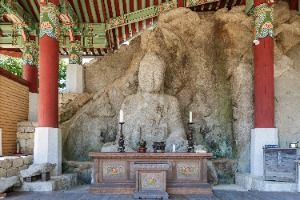
The Bonghwa Bukjiri Seated Buddha Carving is made by carving a large chamber-like space into a natural rock face to house the Buddha statue, in which a 4.3m tall Buddha image is prominently carved. The wide and large face is richly proportioned and wears a slight smile on the front, showing a vivid expression. The shoulders appear somewhat hunched but the figure is dignified, and the robe draped over both shoulders forms thick U-shaped folds across the chest and extends down the arms, covering the pedestal on which the statue sits. The hands are depicted with the right hand raised to the chest and the left hand resting on the knee, enhancing the solemn elegance of the statue. The aureole behind the Buddha is divided into the head aureole and body aureole, featuring small Buddhas sculpted in various places, with a delicate lotus pattern engraved at the center of the head aureole. Considering the softness of the face and body expressions, the statue is estimated to have been made in the late 7th century and together with the Yeongju Gahung-dong Triad Buddha Carving and Seated Buddha (Treasure) represents the Buddhist sculpture style of the Yeongju-Bonghwa area at that time, leaving a significant mark in the history of Silla Buddhist sculpture.
계서당은 조선 중기의 문신인 계서 성이성(1595~1664)선생이 살던 곳이다. 성이성은, 창녕 사람으로 남원 부사를 지낸 부용당 성안의선생의 아들로 인조 5년(1627) 문과에 급제했다. 진주부사등 6개 고을의 수령을 지내고 4번이나 어사로 등용되었으며, 근검과 청빈으로 이름이 높았던 인물이다. 훗날에 부제학으로 추서 받고 청백사로 녹선되었다.
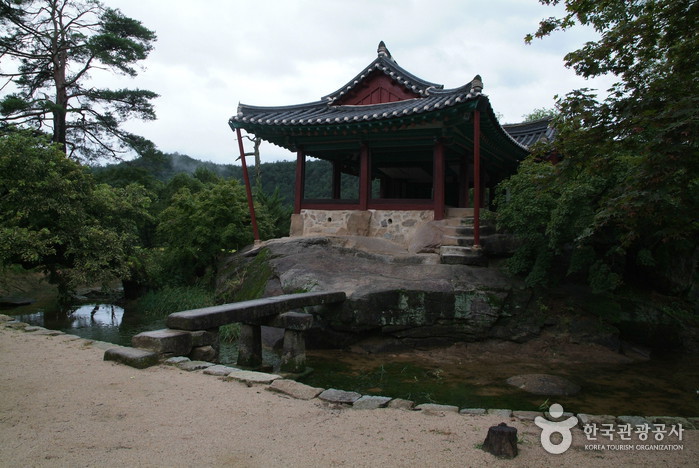
Cheongamjeong is a pavilion built in 1526 (21st year of King Jungjong's reign) by Gwon Beol, a mid-Joseon Dynasty civil official, in Daksil Village (formerly Yugok Village), Bonghwa-eup, Bonghwa-gun, Gyeongsangbuk-do. Cheongamjeong draws water from about 500m upstream of the Sintan and has a pond, a turtle-shaped rock, and a modest stone bridge that enhance the old atmosphere. It is a place with a pond and a garden from the early Joseon period, equipped with a separate annex and surrounded by a square stone wall. A thatched-roof building is attached, and inside the pavilion hangs a signboard inscribed by Heo Mok, reading "Cheongam Suseok (靑巖水石)," preserving the appearance of an old rural pond to the present day. It is a famous scenic spot representing Yugok Village, harmonizing well with the surrounding dense pine trees, beautiful stones, and valleys. On March 28, 1963, it was designated as a historic site and scenic site [Naeseong Yugok Gwonchungjae related sites], later delisted on December 9, 2009, and simultaneously re-designated as a scenic site. Yugok Village was first settled in 1380 by the ancestor of Chungjae Gwon Beol and is a clan village of the Andong Gwon family, with Seokcheon Valley flowing westward.
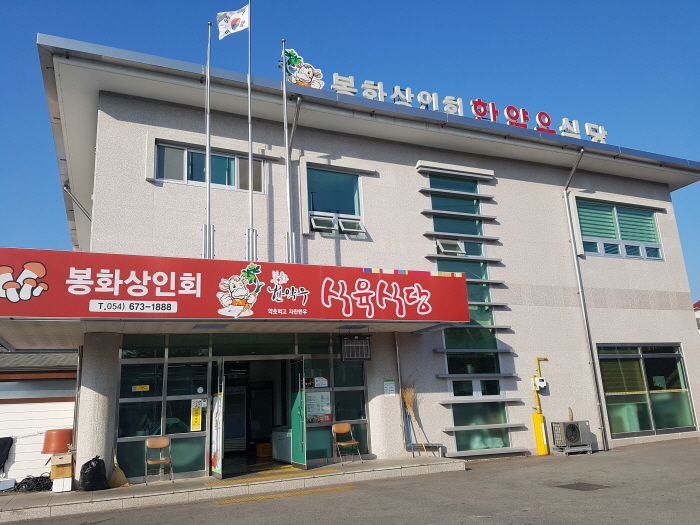
봉화상인회 한약우 식당은 봉화상설상인회에서 협동조합을 구성하여 봉화지역의 약초를 먹고 자란 한우를 판매하는 식당, 식육공간이다
The natural village where Ojeon Mineral Spring is located is called Muljip Village. Ojeon Mineral Spring was discovered by a peddler during the Joseon Dynasty and was selected as the top mineral spring at the national mineral spring contest during the reign of Seongjong, the 9th king of the Joseon Dynasty. It is said that during the 11th king Jungjong's reign, Jusebung, the magistrate of Punggi-gun, often visited this spring, and four praise poems are said to have been passed down. The village where Ojeon Mineral Spring is located was formerly called Aejun, meaning mugwort field. The name originates from the fact that the spring water was effective for skin diseases, and leprosy patients drank and bathed in the mineral water, then used the local mugwort to apply and drink as treatment, curing their illnesses, hence the name Mugwort Field.
Samijeong Valley, located in Socheon-ri, Beopjeon-myeon, Bonghwa-gun, is one of the few remaining pristine areas in South Korea. It is a Y-shaped valley between Taebaek Mountain and Sobaek Mountain, the sources of the Nakdong River, featuring clear and cool streams, dense pine forests, and unique rock formations. At the entrance of the valley, Okcheon Jo Deok-rin, who served as a Ubujeungji during King Yeongjo's reign in Joseon, built a pavilion in 1737 at this scenic spot, naming it Samijeong, from which the valley also took its name. The Ungokcheon stream winds through magnificent rock formations, creating a picturesque and charming scene. Every summer, many visitors come for vacation, and the Bonghwa County Office deploys safety personnel from early June to late August during the water play season to ensure safety and water quality management.
Good places to stop and rest after the course

Booking and payment continue on a partner site.
Check rooms & price
Booking and payment continue on a partner site.
Check rooms & price
Booking and payment continue on a partner site.
Check rooms & price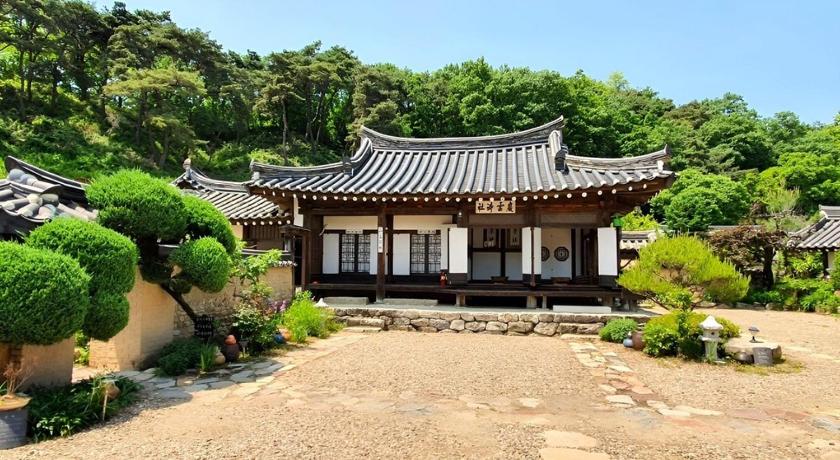
Booking and payment continue on a partner site.
Check rooms & priceSign up to feature your channel.
(As a member, you can add your Instagram, YouTube, and blog links in My Page, and we’ll show them with every comment you write.)
““Stayed near Hongdae and did a night café tour. Perfect city views and vibes.””
Guest comments do not display social media links or profile cards.
Share a short tip about this place.
Or leave a quick comment as a guest.
Photo attachments are available after login.
No reviews yet. Be the first to share your experience!