
寻找宁静的英州书院与古刹 in 庆尚北道 荣州市 · schedule 其他 · distance 36.9km · 4 stops · highlights Sunheung Hyanggyo, 점심식사(순흥전통묵집), Buseoksa Temple [UNESCO World Heritage]

英州拥有我国最早的赐额书院——小修书院,以及顺兴乡校。可以静静地漫步其间。这里没有喧闹的体验活动,但能完整感受到与宁静自然融合的士人精神。盛夏时节,访问这里可在竹溪九曲的清凉水声中忘却暑热。
这条路线是单日行程示例。你可以直接保存,或扩展为 AI 行程。
Sunheung Hyanggyo's exact founding date is unknown, but it is estimated to have been established in the late Goryeo or early Joseon Dynasty. Initially built north of Geumseong in Sunheungbu, it was relocated eastward to Yadong in 1718 (44th year of King Sukjong), then southward to Seokgyo-ri in 1750 (26th year of King Yeongjo), and again moved to its current location in 1770 (46th year of King Yeongjo). It was renovated in 1971 and the pavilion and dancheong were restored in 1975. Originally, Sunheung Hyanggyo served as a Confucian school where local scholars of Sunheung studied, and a site for memorial rites honoring Confucius and other sages. Later, it was used as a local self-governance institution, but from the 16th century onward, due to operational difficulties and socio-economic changes, its educational role diminished, leaving only the memorial rites function. Existing buildings include a 7-room Daeseongjeon, a 6-room Myeongnyundang, 5-room Dongmu and Seomu, 4-room Dongjae, a 7-room gate tower, a Sammun, a Hyepum, and a Jusa. The Daeseongjeon enshrines tablets of the Five Sages and Ten Wise Men; the Dongmu and Seomu enshrine tablets of six Confucian scholars from the Song dynasty and 18 Korean scholars. Additionally, records such as Jipsa-an, Myeonbunryuwonim-an, and Gyojungjaprok, created during the late Joseon period for managing the hyanggyo, are preserved.
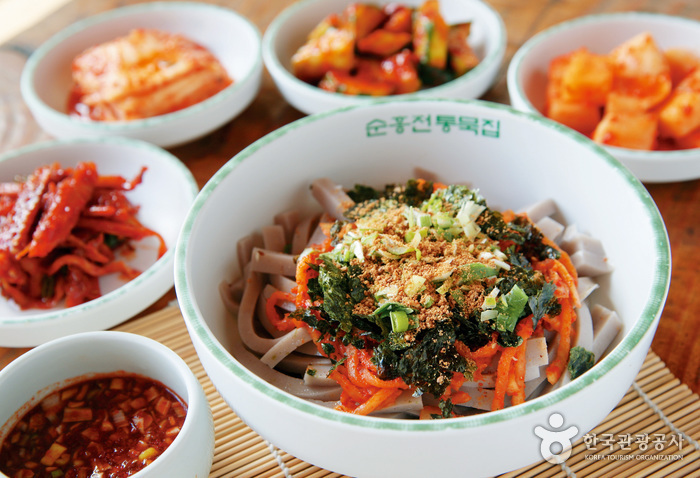
옛날부터 전래되어 내려온 전통적인 방법으로 메밀묵을 제조하여 본래의 맛을 간직한채 묵과 조밥이 함께 어울려 내는 맛은 일품이며, 고향의 맛을 풍기는 메밀묵이다
Buseoksa Temple is a head temple of the Hwaeom Sect, founded in the 16th year of King Munmu’s reign in Silla (676) by the sect’s patriarch Uisang Daesa under royal command. While studying in Tang China, Uisang Daesa heard of the Tang emperor's invasion of Silla, reported this to the king, and returned home to unify the national sentiment and overcome hardships through Hwaeom philosophy, founding this temple as the origin of Korea’s Hwaeom thought. The name Buseoksa comes from a large rock west of the Buddha hall that floats without touching the lower rock, called the “floating rock.” In the Goryeo period, it was called Seondalsa or Heunggyeosa Temple. A manuscript found during restoration in 1916 reveals that Muryangsujeon and others were rebuilt in early Goryeo, but were destroyed by fire in the 7th year of King Gongmin’s reign (1358). Muryangsujeon was rebuilt in the 2nd year of King U’s reign (1376), and Josadang in the 3rd year (1377). The temple grounds contain Unified Silla relics such as the stone lantern in front of Muryangsujeon, stone Buddha statue, three-story stone pagoda, flagpole supports, and stone pedestal, as well as Goryeo relics including Muryangsujeon, Josadang, a clay Buddha statue, Josadang murals, Goryeo woodblocks, and the stele of Wonhyungguksa. Notably, Muryangsujeon is one of Korea’s oldest wooden buildings, and the Josadang murals are the oldest known on wooden structures, now preserved in the artifact museum. The Buddha statue enshrined in Muryangsujeon is the finest clay statue in Korea. The well west of Muryangsujeon is said to be where Uisang Daesa’s guardian dragon lived.
Jukgye Valley is a valley located in Baejeom-ri, Sunheung-myeon, Yeongju-si, Gyeongsangbuk-do, on Sobaeksan Mountain. Jukgye Stream originates from Gungmangbong Peak of Sobaeksan and flows southeast, surrounding Sosu Seowon. The water drops winding around jagged rocks on the Geumdang rock formation resemble scattering crystal beads, creating nine scenic bends called Jukgye Gugok. It was the setting of "Jukgye Byeolgok," a poem by Geunjae An Chuk, a great scholar of the late Goryeo period, and in the mid-Joseon period, scholars such as Sinjae Ju Sebung and Toegye Yi Hwang enjoyed the scenery and composed poetry here. According to Sunheungji, the name Jukgye Gugok was first given by Shin Pil-ha, appointed magistrate of Sunheung in the 4th year of King Yeongjo of Joseon (1728). The distance spans about 2 km from Choaam Geumdang rock (1st bend) to the 9th bend. Currently, only the names of bends 1, 2, 4, 5, and 9 are preserved. Following Jukgye Gugok upward, you can see Choaam Temple, a small temple at the foot of Sobaeksan. This temple originated when Monk Uisang of the Silla period set up a hut here as a temporary residence while choosing a site for Buseoksa Temple and later built the temple where the hut stood, hence named Choaam. The temple fell into ruin during the Korean War but was restored to its current state through the dedicated efforts of Monk I Bowen.
优先展示路线结束后方便休息的住宿
注册成为会员,让更多人认识你的频道。
(成为会员后,在“我的页面”中设置 Instagram、YouTube、博客链接,我们会在你发表的每条评论旁一起展示。)
““住在弘大附近,晚上去了一圈咖啡馆,城市夜景和氛围都太完美了。””
以访客身份发表的评论,不会显示任何社交账号链接或个人资料卡片
分享一条关于这个地点的小贴士吧。
或者以访客身份快速留下一个评论。
请登录后再上传照片。
还没有任何评论,快来写下你的第一条感受吧!


![Buseoksa Temple [UNESCO World Heritage] 1](https://tong.visitkorea.or.kr/cms/resource/42/3572442_image2_1.JPG)
![Buseoksa Temple [UNESCO World Heritage] 2](https://tong.visitkorea.or.kr/cms/resource/44/3572444_image2_1.JPG)
![Buseoksa Temple [UNESCO World Heritage] 3](https://tong.visitkorea.or.kr/cms/resource/45/3572445_image2_1.JPG)
![Buseoksa Temple [UNESCO World Heritage] 4](https://tong.visitkorea.or.kr/cms/resource/52/3572452_image2_1.jpg)


