解除管制的DMZ村庄中的历史 in 京畿道 延川郡 · schedule 其他 · distance 43.3km · 3 stops · highlights Yeoncheon Horogoru, 38선마을, Yeoncheon Sungui-jeon Site

38线村庄曾被管制40多年,村民进出困难。随着管制解除,村民和游客的出行变得更加便利。村庄各处保留了过去的痕迹,沿途还能看到新罗王陵、古代遗址和朝鲜时代的风景。
这条路线是单日行程示例。你可以直接保存,或扩展为 AI 行程。
Horogoru is located at an important gateway connecting Gaeseong and Seoul, built on a basalt cliff formed by a tributary flowing from Wondang-ri into the Imjin River. There are two theories about the origin of the name Horogoru: one says it is named because the nearby terrain resembles a gourd or bottle gourd, and another that it combines 'hol' meaning town and 'goru' meaning fortress. Among Goguryeo defense sites investigated in the Gyeonggi-do area, it is one of the three major flatland fortresses along with Dangposeong and Eundaeriseong. The east wall of Horogoru blocks the eastern part of the basalt plateau, with the highest point reaching 10 meters, offering views of the surrounding area and scenic Imjin River from atop the fortress wall. The first excavation of Horogoru was conducted from November 2000 to May 2002, confirming construction methods and structure of the fortress walls. The total perimeter of Horogoru fortress walls is 401 meters: south wall 161.9m, north wall 146m, east wall 93.1m, covering an internal area of 606㎡ on a roughly 28-meter-high basalt cliff. The east wall shows a construction technique that combines the advantages of stone and earth fortresses by layering packed earth multiple times and raising stone walls on top.
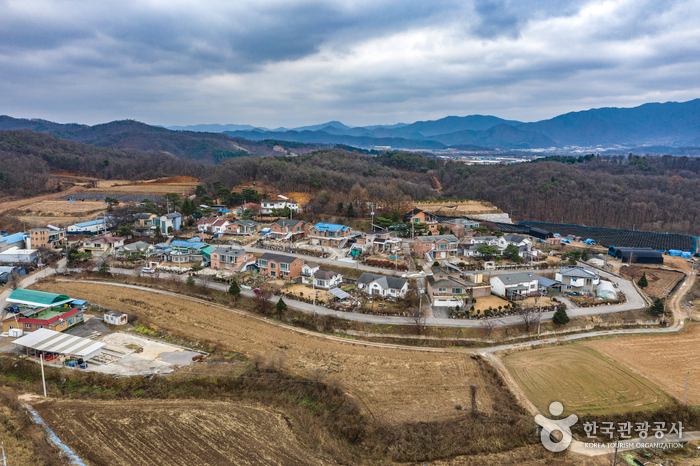
38선마을은 연천군 서남쪽에 위치하여 9km 전방에 휴전선과 마을 입구에 임진강이 흐르고 야산과 농지로 구성되어 있으며 인근에 제1땅굴 및 전곡리 구석기유적지, 경순왕릉, 숭의전 등 문화재가 소재하고 있어 도시민들의 관광과 휴식지역으로 최적지이다.
Sungui-jeon Site [崇義殿址] is the location where Sungui-jeon stood during the Joseon Dynasty, a shrine that enshrined the spirit tablets of kings and meritorious subjects from the previous Goryeo Dynasty and conducted memorial rites. Originally, this place was home to Angamsa Temple [仰巖寺], the original temple of Goryeo's founder King Taejo Wang Geon [王 建]. In 1397, a shrine was established here to enshrine the spirit tablet of King Taejo, becoming the origin of the current Sungui-jeon. After the shrine was built, in 1399 (the 1st year of King Jeongjong's reign), by royal decree, spirit tablets of eight Goryeo kings—including Taejo, Hyejong [惠宗], Seongjong [成宗], Hyeonjong [顯宗], Munjong [文宗], Wonjong (Chung-gyeong King 元宗), Chungnyeolwang [忠烈王], and Gongminwang [恭愍王]—were enshrined. The currently reconstructed buildings consist of Sungui-jeon, measuring three kan in front and three kan in depth, along with five auxiliary buildings: Baesincheong, Iancheong, Jeonsacheong, etc., as well as three gates—Naesinmun, Oesinmun, and Hyupmun—and six gates including Unjomon.
优先展示路线结束后方便休息的住宿
注册成为会员,让更多人认识你的频道。
(成为会员后,在“我的页面”中设置 Instagram、YouTube、博客链接,我们会在你发表的每条评论旁一起展示。)
““住在弘大附近,晚上去了一圈咖啡馆,城市夜景和氛围都太完美了。””
以访客身份发表的评论,不会显示任何社交账号链接或个人资料卡片
分享一条关于这个地点的小贴士吧。
或者以访客身份快速留下一个评论。
请登录后再上传照片。
还没有任何评论,快来写下你的第一条感受吧!