从恐龙足迹到传统村落的义城历史之旅 in 庆尚北道 义城郡 · schedule 其他 · distance 16km · 6 stops · highlights Uiseong Gyeongdeokwang Tomb, Uiseong Tapriri Five-Story Stone Pagoda,…

义城是三韩时代部落国家小文国和朝文国历史遗存的地方。这里不仅有祭鱼里恐龙足迹化石产地,还有模仿前塔技法的国宝塔里五层石塔、被指定为天然纪念物的沙村街树林,以及朝鲜时代代表性的两班村落山云村,适合进行历史旅行。冰穴和冰穴存在的冰溪谷冰山寺址五层石塔也是不可忽视的文化遗产。
这条路线是单日行程示例。你可以直接保存,或扩展为 AI 行程。
Uiseong Gyeongdeokwang Tomb is a burial mound located in Daeriri, Geumseong-myeon, Uiseong-gun, and is believed to be the tomb of Gyeongdeokwang of Jomunguk. Jomunguk was a tribal state during the Samhan period, with its capital around present-day Geumseong-myeon, Uiseong-gun, Gyeongsangbuk-do, and is said to have been annexed by Silla in 185. However, records of Jomunguk’s actual existence are brief and only mentioned shortly in the Samguk Sagi, with few other historical documents remaining. The ancient Gyeongdeokwang Tomb of Jomunguk is a traditional-style burial mound with a granite stele and topstone beneath the mound. The tomb’s circumference is 74 meters and its height 8 meters, with a stele at the front measuring 42 cm wide, 22 cm deep, and 1.6 meters tall. In 1725, the local governor Lee Wooshin expanded the tomb and erected a stone signpost, and royal memorial rites were held from then until they were interrupted during the Japanese occupation. Afterward, the Gyeongdeokwang Tomb Preservation Society was formed to resume the rites. The burial ground, surrounded by pine trees, is decorated with a stele inscribed with “Jomunguk Gyeongdeokwang Tomb,” alongside civilian stone figures, lantern stones, and a topstone. Next to it is the Jomunguk Burial Mound Exhibition Hall, built on the site where Daeri-ri Burial Mound No. 2 once stood. After excavation, the interior of the tomb was displayed for visitors to easily understand the artifacts and burial customs, with relics excavated from No. 2 also exhibited.
This is a five-story stone pagoda from the Unified Silla period, erected in the village of Tapriri. It features a five-story pagoda body standing on a low single-tier platform (gidan), with a unique structure that simultaneously showcases the style of a brick pagoda (jeontap) made by shaping stones into brick forms and traditional wooden architectural techniques. The platform is constructed by laying multiple stones as the base, and its central and corner pillars are each made from different stones, imitating wooden architecture. The first story of the pagoda body is tall, with the height sharply decreasing from the second story onward; the first story chamber houses a niche (gamsil) enshrining a Buddha statue. The roof stones are tiered on both the underside and the upper side, with six tiers on top and five on the bottom, as seen in brick pagodas. The corners of the roof stones are slightly uplifted, reminiscent of wooden roof eaves. This work applies wooden architectural styles in multiple parts while also demonstrating brick pagoda construction techniques, making it a valuable resource for studying early Unified Silla stone pagoda styles along with the Gyeongju Bunhwangsa Mojeon Stone Pagoda (National Treasure).
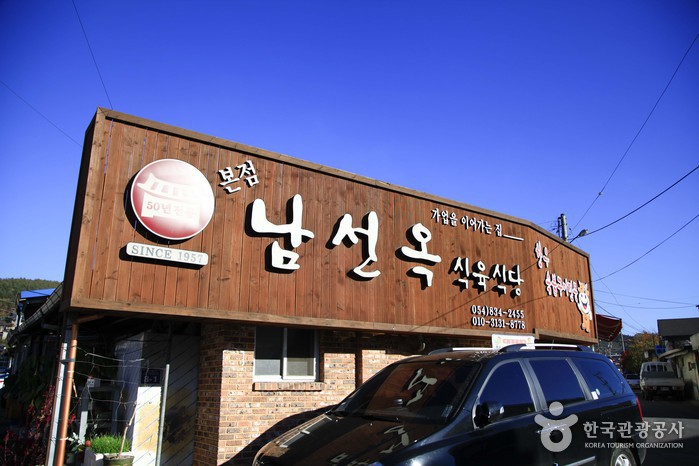
남선옥 식육식당은 국내산 순수한우만을 취급하는 50년 전통의 한우 숯불구이 전문점이다.
Sanun Village is a traditional Bannchon called Daegam Village in Uiseong, a natural scenic Yeongcheon Lee clan[永川李氏] settlement. The village is situated on gentle hills and plains, with Geumseongsan Mountain, which holds many legends, behind it and Bibong Mountain beside it. A reservoir lies in the Geumseongsan valley by the village, with rice paddies spreading along the valley. To the south, Ssanggyegcheon Stream flows, fostering surrounding farmland. Feng shui-wise, it is a typical backs-to-mountain and fronts-to-water terrain, described as a 'fairy sitting before a mirror combing her hair.' The name Sanun[山雲] originated during the flourishing Buddhist Silla era when clouds could be seen drifting below Sujeong Valley. The scholar Lee Gwangjun, who served as Gangwon Province governor in the Joseon Seonjo period, settled here and formed the village. Later residents included Gyeongjeong Lee Minseong, who served as royal secretary during King Gwanghaegun’s reign, and Ungok Lee Heebal, Minister of Justice during King Hyeonjong’s reign. The village is a traditional settlement with many designated cultural assets and traditional houses such as Haknok Jeongsa, Uiseong Ungokdang, Uiseong Sowoodang, and Uiseong Jeomoodang. Visitors can also experience hanok stays and enjoy Sanun Ecological Park adjacent to the village.
Uiseong Sanun Ecological Park was established in 2006 using the former Sanun Elementary School (closed) to foster natural learning and environmental values for future generations. Major facilities include an ecology center, pond, fountain, wooden bridge, and observation deck. The spacious yard is planted with over 50 species of trees, grasses, and flowers. The 1st exhibition hall displays materials on earthquakes, volcanic activity, the origin of life, and the birth of the Earth. The 2nd exhibition hall covers human evolution and classification of animals and plants. The 3rd exhibition hall offers dinosaur fossils and a timeline of dinosaurs. Additionally, there is an ecology center with information on the origin, specialties, and tourism of Uiseong-gun, and a village museum exhibiting the history of Sanun Village.
Binggye Valley is a valley attraction with beautiful natural scenery, designated as a county park. It consists of basalt and rhyolitic tuff formed by Mesozoic Cretaceous volcanic activity. The stream (Ssanggyecheon) flows from northeast to southwest, generally matching the direction of the fault passing through here. The main attractions are the 'ice hole' where ice forms and the 'wind hole' where cold air blows out, registered as the natural monument 'Uiseong Binggye-ri Ice Cave.' Especially, the ice hole has an average temperature of 0.3℃, more than 10℃ lower than the outside temperature, with the highest temperature throughout the year below 5℃, and it has the longest freezing period in Korea (early March to early October). This low-temperature phenomenon occurs because the columnar joints developed on the fluvial cliff create a talus slope formed by weathering and erosion. It is explained by heat exchange through air circulation, and the airflow direction formed in the talus changes with seasons because the temperature of the air stored in the talus and the outside temperature vary. In late autumn to winter, cold outside air enters the talus, continuously settling and getting trapped at the bottom. In spring to summer, cold air inside the talus exits through the bottom, blowing out more strongly while warm outside air enters the talus. Northern plant species like Jommiyokgosari and Handeulgosari appear near this area. (Source: Uiseong Geopark)
优先展示路线结束后方便休息的住宿
注册成为会员,让更多人认识你的频道。
(成为会员后,在“我的页面”中设置 Instagram、YouTube、博客链接,我们会在你发表的每条评论旁一起展示。)
““住在弘大附近,晚上去了一圈咖啡馆,城市夜景和氛围都太完美了。””
以访客身份发表的评论,不会显示任何社交账号链接或个人资料卡片
分享一条关于这个地点的小贴士吧。
或者以访客身份快速留下一个评论。
请登录后再上传照片。
还没有任何评论,快来写下你的第一条感受吧!