从安全到历史的益山五感旅行路线 in 全北特别自治道 益山市 · schedule 1晚2天 · distance 44.3km · 6 stops · highlights Agape Garden, Iksan Jungang Market, Iksan Mireuksaji [UNESCO Wor…

益山是一座可以享受智能安全体验、千年遗产、本地美食、自然散步和独特文化体验的城市。行程从再现实际工业现场的益山安全体验馆开始,随后在中央市场品尝传统市场美食,之后在弥勒寺址体验被列为联合国教科文组织世界遗产的百济文化气息。此外,在阿加佩花园或九龙村竹林中可以感受自然的宁静,在益山监狱拍摄场体验独特文化,最后在罗拔圣堂的哥特式建筑美景中平静结束旅行。
这条路线是 2 天行程示例。你可以直接保存,或扩展为 AI 行程。
Agape Garden is Jeollabuk-do's 4th private garden, registered with 1,416 trees of 17 species including metasequoia, Korean nut pine, and peacock maple. In 1970, the late Father Seo Jeong-su established the Agape Nursing Home for the elderly and created this nature-friendly tree garden to promote healthy and happy aging for the facility’s seniors. The garden, maintained like an arboretum as an evergreen forest, was opened to the public and registered as a private garden in March 2021. After renovations, it was reborn as a rest area for citizens. Each season showcases beautiful flowers such as daffodils, tulips, magnolias, and poppies. The walking path lined with towering metasequoias resembling a fence is impressive. Walking through the forest path of ornamental trees including juniper, pine, larch, peacock maple, and crepe myrtle, visitors can feel the fresh natural air blending with the surrounding scenery, evoking deep nostalgia. Visitors on weekends and holidays must make a reservation two weeks in advance.
Jungang Market is a permanent market that opened in April 1947, serving as a place of meeting and communication with Iksan citizens for many years. The first floor sells clothing, hanbok, accessories, and agricultural and marine products, while the second floor hosts shops selling medicinal herbs, rice cakes, side dishes, meat, and restaurants. To revitalize the traditional market, Jungang Market was newly renovated a few years ago, featuring a ceiling for rainy days and distinctive themed streets. It has transformed into a 21st-century customer-tailored market providing reliable local products and food. Additionally, the market has signs that are rarely seen in traditional markets, reflecting efforts and consideration for customers visiting the traditional market.
The founding of Mireuksa, the largest Buddhist temple complex of Baekje, is recorded in the Samguk Yusa. Ma Dong, who became King Mu (the 30th king of Baekje, 600–641) after marrying Princess Seonhwa of Silla, was on his way with her to visit the priest Jibyeom of Sajasa at Yonghwasan (present-day Mireuksan). Suddenly, the Three Bodhisattvas of Maitreya appeared from the pond, which led to the founding of Mireuksa. It is said that the shrine (Geumdang), pagoda, and Nangmu (Hwarang) were constructed for the Three Bodhisattvas. Another view suggests that in addition to the faith of King Mu and Princess Seonhwa, the founding of Mireuksa had political purposes, speculated to have been established in Geumma, a center of Mahan power, to expand Baekje’s national strength. The establishment of Mireuksa, Baekje’s largest temple complex, likely demonstrated the highest level of architectural and craft culture at the time. As recorded in Samguk Yusa, King Jinpyeong of Silla sent Baekgong to help, indicating that skills from the Three Kingdoms were combined. Mireuksa was clearly the focal point of Maitreya faith in Baekje Buddhism, contrasting with Hwangnyongsa of Silla, which centered on Huayan Thought and had one pagoda and three shrines. Mireuksa’s layout featured three pagodas and three shrines, embodying Maitreya Thought, while Hwangnyongsa embodied Huayan Thought centered on the king. Mireuksa’s Maitreya faith aimed to lead even common people to the Lotus World. * Additional relics at Mireuksaji: Mireuksaji Stone Pagoda and Dangganjiju * Mireuksaji contains two notable relics: the Stone Pagoda and the Dangganjiju (flagpole supports). The Mireuksaji Stone Pagoda, a National Treasure, is currently 14.24 meters tall, making it Korea’s tallest and largest stone pagoda. Although almost entirely collapsed, six tiers remain on the northeast corner, but it is estimated originally to have had nine tiers. Research by Wonkwang University’s Mahan Baekje Culture Research Institute in 1974–1975 revealed the eastern pagoda was stone, not wooden, confirming the so-called east-west twin pagoda layout. Excavations later verified nine tiers of the eastern pagoda, which was restored to nine tiers (27.67 m) in 1993. This pagoda is regarded as Korea’s finest because its style meticulously reproduces the wooden pagoda design in stone. Dangganjiju are the pillars built on either side of the flagpole to support it. The Mireuksaji Dangganjiju, designated a Treasure, stands 395 cm tall and is estimated to date before the mid-Unified Silla period. Two pillars stand about 90 meters apart facing each other east-west, south of the stone pagoda.
익산 미륵산 자락에 있는 구룡마을 대나무 숲의 전체 면적 50,000㎡ 정도로 한강 이남의 최대 대나무 군락지이다. 분포하고 있는 주요 수종은 왕대이며, 일부 구간에 검은 대나무인 오죽 또는 분죽이라 부르는 솜대가 자라고 있다.
익산시 성당면 와초리 성당초등학교 남성분교 폐교부지 위에 세워진 국내 유일의 영화 촬영용 교도소 세트장이다. 이곳에서 영화 ‘홀리데이’의 현실감 넘치는 교도소 장면이 연출되었고, 이외에도 ‘아이리스’, ‘전설의 마녀’, ‘7번 방의 선물’, ‘내부자들’ 등 200여 편의 영화와 드라마가 촬영되었다.
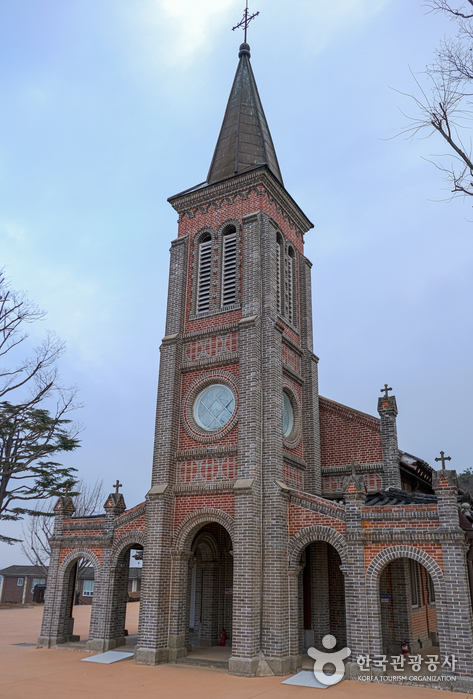
Nabawi Cathedral was established to commemorate the landing of Father Kim Dae-geon, who was ordained a priest in China in the 11th year of King Heonjong of Joseon (1845), and Bishop Ferréol Di Bali, who landed at Hwangsan ferry. The first parish priest, Father Vermonel (Jang Yakseul, Joseph), led the construction of the building beginning in 1906, completed in 1907. The cathedral's design was assisted by Father Poinel of Myeongdong Cathedral, and the construction was carried out by Chinese workers. Nabawi Cathedral is designated a sacred site by the Korean Catholic Church, as it is where the first Korean priest Saint Kim Dae-geon began his missionary work. The building harmonizes Western cathedral architectural styles with Korean architecture, reflecting the introduction and development of Catholicism in Korea. Between 1916 and 1917, the earthen walls were replaced with brick, and a Gothic brick bell tower was added. The cathedral's traditional Korean wooden structure with tiled roof and corridor reflects Korean aesthetics. The octagonal windows designed for lighting create unmatched beauty, harmonizing with pine trees at night. Originally called Hwasan Catholic Church, it has been renamed Nabawi Cathedral. Nabawi Cathedral, as a Korean Catholic sacred site, offers several sights to see. The first is the martyrdom monument of Father Kim Dae-geon, erected on the 100th anniversary of his martyrdom. The second is Manggeumjeong, meaning 'hoping for beauty,' a pavilion built in 1915 by Father Vermorel to support Bishop Demange’s retreat, the first bishop of Daegu Diocese. This pavilion is located on the large rock Nabawi at the edge of Hwasan, blending beautifully with the surrounding scenery. Below the rock where Manggeumjeong stands, one can see the wall-carved Buddha Triad known as Maae Samjonbul.
优先展示路线结束后方便休息的住宿
注册成为会员,让更多人认识你的频道。
(成为会员后,在“我的页面”中设置 Instagram、YouTube、博客链接,我们会在你发表的每条评论旁一起展示。)
““住在弘大附近,晚上去了一圈咖啡馆,城市夜景和氛围都太完美了。””
以访客身份发表的评论,不会显示任何社交账号链接或个人资料卡片
分享一条关于这个地点的小贴士吧。
或者以访客身份快速留下一个评论。
请登录后再上传照片。
还没有任何评论,快来写下你的第一条感受吧!


![Iksan Mireuksaji [UNESCO World Heritage] 1](https://tong.visitkorea.or.kr/cms/resource/58/3533758_image2_1.jpg)
![Iksan Mireuksaji [UNESCO World Heritage] 2](https://tong.visitkorea.or.kr/cms/resource/59/3533759_image2_1.jpg)
![Iksan Mireuksaji [UNESCO World Heritage] 3](https://tong.visitkorea.or.kr/cms/resource/60/3533760_image2_1.jpg)
![Iksan Mireuksaji [UNESCO World Heritage] 4](https://tong.visitkorea.or.kr/cms/resource/61/3533761_image2_1.jpg)