走访士大夫之乡咸阳的花林洞溪谷 in 庆尚南道 咸阳郡 · schedule 其他 · distance 44.6km · 4 stops · highlights Namgye Seowon [UNESCO World Heritage], Gibaeksan Yongchu Valley and Y…

咸阳与安东一起,是庆尚道代表性的士大夫之乡。这里是点笔斋金宗直的故乡,可以参观他的墓地和书院。作为士大夫之乡,越过六十岭的路上有花林洞溪谷,那里保留着自古以来文人吟诗游玩的亭子。溪谷和亭子沿线设有士大夫文化探访路,适合漫步游览。
这条路线是单日行程示例。你可以直接保存,或扩展为 AI 行程。
Hamyang Namgye Seowon was established in 1552 (the 7th year of Myeongjong) by Gaeam Kang Ik to restore the Daoist heart of loving others as oneself (Confucian education) and to honor the scholarly virtues of Ildu Jeong Yeo-chang. In 1566 (the 21st year of Myeongjong), it was granted the name 'Namgye.' It was burned down during the Jeongyu War in 1597 but was relocated to Nachon in 1603 (the 36th year of Seonjo), then rebuilt at its current site in 1612 (the 4th year of Gwanghaegun). Namgye Seowon utilized the topographical features with a unique layout of front academic space and rear ritual space, establishing a standard for seowon architecture known as jeonhak-hu-myo, which became a model for later seowons. Hamyang Namgye Seowon is one of 47 seowons that survived the 1868 seowon abolition decree by Heungseon Daewon-gun and the only remaining seowon in Gyeongnam. It was inscribed as a UNESCO World Heritage site in 2019.
Gibaeksan Yongchu Valley was known in the old Anui-hyeon as one of three magnificent scenic spots called 'Anui Samdong.' Among them, Yongchu Valley is also called 'Simjindong,' meaning 'a place immersed in the truth as a result of the deep valley’s beauty.' At the entrance of Yongchu Valley is the pavilion Simwonjeong, considered the essence of Simjindong, along with Cheongsindam, a clear pond, and a layered granite rock formation spread out at once. About 3 km beyond Simwonjeong lies Jangsu Temple's Jogye Gate (Iljumun) standing alone behind a large parking lot. Founded by monk Gakyeon in the 9th year of King Soji of Silla, Jangsu Temple was destroyed in the Korean War leaving only the Iljumun, and has not been restored. Further up from Iljumun is Yongchu Temple, in front of which is Yongchu Waterfall, where the thunderous sound of water can be heard. At the end of Yongchu Valley is the Yongchu Natural Recreation Forest created by Hamyang County, equipped with charming mountain huts, a large parking lot, a water play area, and an observatory. Hiking trails are established here to climb Gibaeksan and Hwangseoksan, ridges of Namdeogyusan.
Ani Original Galbi Restaurant has been in operation since 1962, maintaining its reputation as a premium Korean beef galbi restaurant. It is designated as a regional specialty restaurant by Hamyang-gun. The menu consists of only two items: galbijjim (braised short ribs) and galbitang (short rib soup). This reputable galbi restaurant has long prepared galbijjim in the Anui area. The galbitang, seasoned with traditionally brewed soy sauce made in-house, is one of the establishment's longstanding menu items.
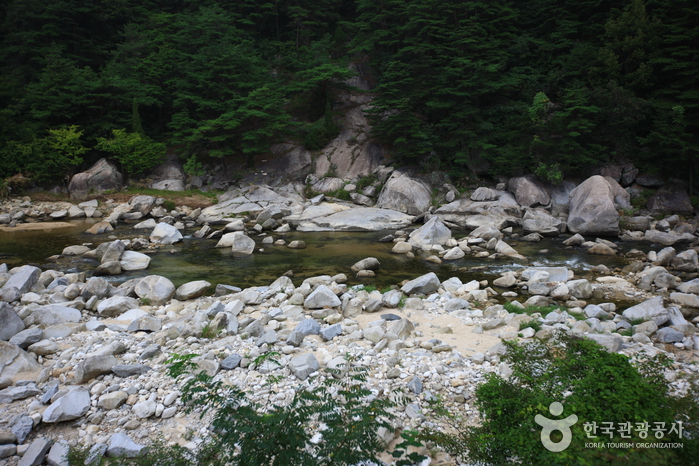
Hwarimdong Valley extends for 60 ri (15 km), where Geumcheon (upper stream of Namgang), originating from Namdeoksan Mountain at an elevation of 1,508 meters, flows from Seosang to Seoha. Along the stream, it forms remarkable rocks and pools, and at Nongwoljeong, the flowing jade waters over the rock slabs blend with pine trees to create a landscape like a utopia. Known as a mecca of Korea's pavilion culture, the valley features numerous pavilions and bizarre rock formations scattered across a wide rock bed. Nongwoljeong is where Master Park Myeong-bu from this region, who passed the civil service exam during the Joseon Seonjo era, served as Vice Minister of Rites, raised militia troops during the Imjin War, and held poetry gatherings while fishing over time. The area around Nongwoljeong has been developed by Hamyang-gun into a national tourism complex welcoming visitors.
优先展示路线结束后方便休息的住宿
注册成为会员,让更多人认识你的频道。
(成为会员后,在“我的页面”中设置 Instagram、YouTube、博客链接,我们会在你发表的每条评论旁一起展示。)
““住在弘大附近,晚上去了一圈咖啡馆,城市夜景和氛围都太完美了。””
以访客身份发表的评论,不会显示任何社交账号链接或个人资料卡片
分享一条关于这个地点的小贴士吧。
或者以访客身份快速留下一个评论。
请登录后再上传照片。
还没有任何评论,快来写下你的第一条感受吧!
![Namgye Seowon [UNESCO World Heritage] 1](https://tong.visitkorea.or.kr/cms/resource/27/3538327_image2_1.jpg)
![Namgye Seowon [UNESCO World Heritage] 2](https://tong.visitkorea.or.kr/cms/resource/28/3538328_image2_1.jpg)
![Namgye Seowon [UNESCO World Heritage] 3](https://tong.visitkorea.or.kr/cms/resource/29/3538329_image2_1.jpg)
![Namgye Seowon [UNESCO World Heritage] 4](https://tong.visitkorea.or.kr/cms/resource/30/3538330_image2_1.jpg)