
铁原,身心平和,温泉疗养旅行 in 江原特别自治道 哲原县 · schedule 其他 · distance 17.4km · 3 stops · highlights Goseokjeong National Tourist Site, Dopiansa Temple, Cheorwon Worker…
每年深秋,铁原的温泉主题温泉节在高石亭国民旅游地和汉滩河水疗酒店一带举办。高石亭国民旅游地因设有汽车露营场、房车和生态池塘等设施,四季皆适合家庭旅行,是家庭疗养休闲地。劳动党舍是朝鲜战争遗迹,作为近代文化遗产保存完好。现今该地作为音乐录像拍摄和音乐会场所,具有文化价值和历史建筑意义。
这条路线是单日行程示例。你可以直接保存,或扩展为 AI 行程。
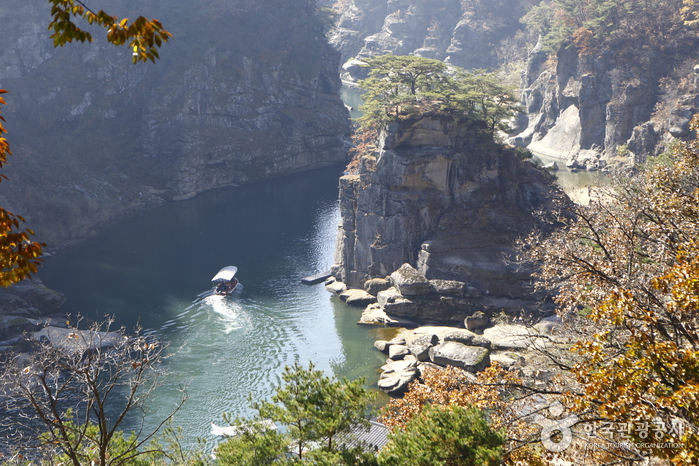
Goseokjeong is one of the nine scenic spots of Cheorwon and the most famous attraction in the area. Towering about 10 meters high in the middle of the Hantan River, a crystal-clear stream flows swirling between the two imposing rock formations. It is said that during the reign of King Jinpyeong of Silla, a two-story pavilion about 10 pyeong in size was built on the middle course of the Hantan River and named Goseokjeong. The pavilion and the valley around Goseok Rock together are called Goseokjeong. Designated as a local monument, it is said that King Jinpyeong of Silla and King Chungsuk of Goryeo visited and enjoyed this place. Goseokjeong became more famous as it was known as the base of Im Geokjeong during the Joseon Dynasty in the era of King Myeongjong. Cheorwon, formed by basalt lava flows in the Quaternary of the Cenozoic era, has the Hantan River flowing from north-northeast to south-southwest, creating columnar joints and vertical cliffs of granite through erosion. Located at the center of the Chugaryeong structural belt and later the passage of the Gyeongwon Line, Cheorwon was a suitable place for Im Geokjeong to hide, as he built a high stone wall opposite Goseokjeong as a mountain fortress base. He resisted the corrupt social class by intercepting tributes passing through this area to the royal court from Hamgyeong-do and aiding the poor. The pavilion was destroyed during the Korean War but was rebuilt in 1971 with local support as a 10-pyeong two-story structure; it was washed away by floods in 1996 and reconstructed again in 1997. Currently, a natural stone chamber where Im Geokjeong hid can be found in the massive 20-meter-high rock in the middle of the river, and a stone fortress remains on the opposite side. This scenic spot remains a national tourist site of Cheorwon’s nine views, attracting visitors year-round. About 2 km upstream are Jiktang Waterfall and about 2 km downstream is Sundam, with wide lawns and multipurpose sports grounds available, making it a favored destination throughout the seasons.
Dopiansa Temple in Cheorwon is a temple located in Dongsong-eup, Cheorwon-gun, Gangwon-do, founded in the 5th year of King Gyeongmun of the Unified Silla period (865). Inside the temple, there is the oldest iron sitting Birojanabul (Iron Buddha) statue made by Doseon Guksa in Korea, which is a national treasure, and a three-story stone pagoda made of granite, designated as a treasure, standing 4.1 meters tall. According to legend, Doseon Guksa created the 91cm iron sitting Birojanabul and, while traveling with several monks to enshrine it at Anyangsa Temple in Cheorwon-eup, the statue mysteriously disappeared during a short rest. After searching the area, they found it at the current location. A small hermitage was built at the site to enshrine the Buddha image, and the temple was named Dopiansa, meaning the Buddha reached an eternal resting place, Pian. Doseon regarded this temple as one of the Bibogukchal (temples that protect the nation), and because Mt. Hwage was shaped like a lotus floating on water, the stone pagoda and iron Buddha were installed to compensate for the mountain's weak points, thereby strengthening the nation's stability and defense against foreign invasions. The three-story stone pagoda was built at the temple's founding, with patterns engraved on each side of the body and a lotus bud-shaped ornament on top. This pagoda was designated as Treasure No. 112 in 1963. Other Buddhist-related buildings on the temple grounds include Daejeokgwangjeon, housing the iron Birojanabul statue; Jongnugak, where the temple bell was hung; and Cheonbuljeon, containing one thousand small Buddha statues. Previously restricted as a civilian control area, the temple is now open to the public without limitation.
The Workers' Party Headquarters located in Gwanjeon-ri, Cheorwon-eup, Gangwon Province, is a three-story building completed in 1946. Until the outbreak of the Korean War, it was used as the Workers' Party Headquarters of North Korea. Currently, the entire building is blackened and densely marked with shell and bullet holes due to extensive damage during the Korean War. However, this appearance reminds visitors of the Korean War and the reality of Korea's division, leading to its use as a filming location for famous singers' music videos and as a venue for well-known concerts. Presently, the Cheorwon Workers' Party Headquarters is operated as a security tourism course by Cheorwon-gun and attracts many tourists. It has been under government protection since being registered as a modern cultural heritage in February 2001.
优先展示路线结束后方便休息的住宿
注册成为会员,让更多人认识你的频道。
(成为会员后,在“我的页面”中设置 Instagram、YouTube、博客链接,我们会在你发表的每条评论旁一起展示。)
““住在弘大附近,晚上去了一圈咖啡馆,城市夜景和氛围都太完美了。””
以访客身份发表的评论,不会显示任何社交账号链接或个人资料卡片
分享一条关于这个地点的小贴士吧。
或者以访客身份快速留下一个评论。
请登录后再上传照片。
还没有任何评论,快来写下你的第一条感受吧!


