統制が解除されたDMZの村で出会う歴史 in 京畿道 延川郡 · schedule その他 · distance 43.3km · 3 stops · highlights Yeoncheon Horogoru, 38선마을, Yeoncheon Sungui-jeon Site

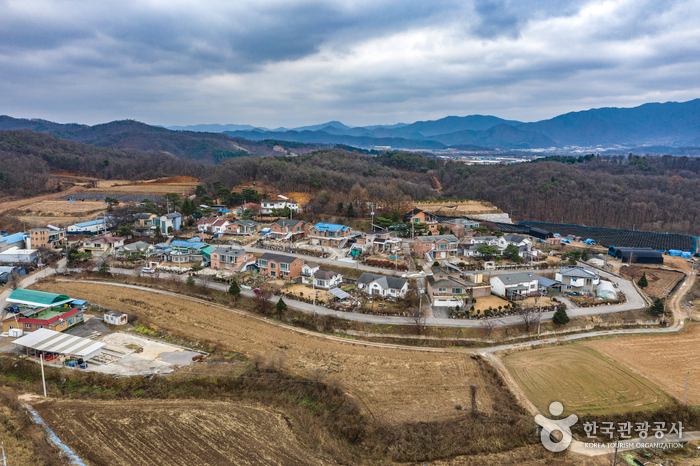
約40年間統制されていたため、村の住民も行き来が難しかった38線の村がある。統制が解除されてからは、住民だけでなく訪問者の足取りも軽くなった。村の各所で過去の痕跡を見つけることができる。村へ向かう道中には、新羅の王陵や古代遺跡、朝鮮時代の風景も見ることができる。
このコースは1日旅程のサンプルです。そのまま保存するか、AI日程に拡張できます。
Horogoru is located at an important gateway connecting Gaeseong and Seoul, built on a basalt cliff formed by a tributary flowing from Wondang-ri into the Imjin River. There are two theories about the origin of the name Horogoru: one says it is named because the nearby terrain resembles a gourd or bottle gourd, and another that it combines 'hol' meaning town and 'goru' meaning fortress. Among Goguryeo defense sites investigated in the Gyeonggi-do area, it is one of the three major flatland fortresses along with Dangposeong and Eundaeriseong. The east wall of Horogoru blocks the eastern part of the basalt plateau, with the highest point reaching 10 meters, offering views of the surrounding area and scenic Imjin River from atop the fortress wall. The first excavation of Horogoru was conducted from November 2000 to May 2002, confirming construction methods and structure of the fortress walls. The total perimeter of Horogoru fortress walls is 401 meters: south wall 161.9m, north wall 146m, east wall 93.1m, covering an internal area of 606㎡ on a roughly 28-meter-high basalt cliff. The east wall shows a construction technique that combines the advantages of stone and earth fortresses by layering packed earth multiple times and raising stone walls on top.
38선마을은 연천군 서남쪽에 위치하여 9km 전방에 휴전선과 마을 입구에 임진강이 흐르고 야산과 농지로 구성되어 있으며 인근에 제1땅굴 및 전곡리 구석기유적지, 경순왕릉, 숭의전 등 문화재가 소재하고 있어 도시민들의 관광과 휴식지역으로 최적지이다.
Sungui-jeon Site [崇義殿址] is the location where Sungui-jeon stood during the Joseon Dynasty, a shrine that enshrined the spirit tablets of kings and meritorious subjects from the previous Goryeo Dynasty and conducted memorial rites. Originally, this place was home to Angamsa Temple [仰巖寺], the original temple of Goryeo's founder King Taejo Wang Geon [王 建]. In 1397, a shrine was established here to enshrine the spirit tablet of King Taejo, becoming the origin of the current Sungui-jeon. After the shrine was built, in 1399 (the 1st year of King Jeongjong's reign), by royal decree, spirit tablets of eight Goryeo kings—including Taejo, Hyejong [惠宗], Seongjong [成宗], Hyeonjong [顯宗], Munjong [文宗], Wonjong (Chung-gyeong King 元宗), Chungnyeolwang [忠烈王], and Gongminwang [恭愍王]—were enshrined. The currently reconstructed buildings consist of Sungui-jeon, measuring three kan in front and three kan in depth, along with five auxiliary buildings: Baesincheong, Iancheong, Jeonsacheong, etc., as well as three gates—Naesinmun, Oesinmun, and Hyupmun—and six gates including Unjomon.
コース後に休みやすい宿を集めました
会員登録して自分のチャンネルも一緒に紹介してもらう
(会員になると、マイページで設定した Instagram・YouTube・ブログのリンクが、あなたのコメントと一緒に表示されます。)
“「弘大近くに滞在して、夜のカフェ巡りをしました。街の夜景も雰囲気も最高でした。」”
ゲストとして投稿したコメントには、SNSリンクやプロフィールカードは表示されません。
この場所についてのちょっとしたコツや感想をシェアしてください。
ゲストとして、気軽にひとことコメントを残すこともできます。
写真の添付はログイン後に利用できます。
まだレビューがありません。最初の感想を投稿してみましょう!