300年の時を五感で感じる一夜 in 忠清南道 西山市 · schedule その他 · distance 28.2km · 3 stops · highlights Seosan Bowon Temple Site, Gaesimsa Temple, Seosan Haemi Eupseong

忠南西山市ハンダリ村は慶州金氏の集落である。安州牧使を務めた金淵が瑞興府使として在職中に林巨正を討伐し得た賜牌地を基に約500年前に入植し、集落を形成した。この地の古風な雰囲気と整った伝統料理の体験も忘れてはならない。
このコースは2日間の旅程サンプルです。そのまま保存するか、AI日程に拡張できます。
This site was where Bowon Temple existed from the Baekje period to the Joseon dynasty, holding a thousand years of history and many Buddhist cultural assets. Major cultural properties here include the 4-meter-high Dangganjiju (flagpole supports) that suggest the temple's scale, the five-story stone pagoda, stone statues, the Beopin Guksa pagoda, and the Beopin Guksa monument, all designated as treasures due to their great value. At one time, the temple housed about a thousand monks, and even by today's standards, the temple site deep in the mountains is so vast that it cannot be seen all at once. The gilt-bronze standing Buddha, iron standing Buddha, and iron seated Buddha statues excavated from Bowon Temple Site were moved to the National Museum of Korea in Seoul, but traces that suggest the grandeur of this millennium-old temple can still be found scattered around the site. Recognized for its value, it was designated a historic site in 1987, and it is especially notable that this area was significant during the Baekje period. Today, it is being reconstructed as a branch temple of Sudeoksa Temple in the 7th district of the Jogye Order of Korean Buddhism. Nearby are the Maae Samjon Buddha Rock Carving of Yonghyeon-ri in Seosan, another Baekje Buddhist cultural asset, as well as Yonghyeon Valley, Gayasan Mountain, and Gopung Reservoir. The Seosan Arame-gil Millennium Smile Trail and its circular route also pass through here, making it favorable for linked tourism.
Gaesimsa Temple, located in Sinchang-ri, Unsan-myeon, is one of the four major temples in Chungnam. It was founded by Monk Hyegam in 654, the 14th year of King Uija of Baekje, and is said to have been renovated by Cheoneung Daesa in 1350, the 2nd year of King Chungjeong of Goryeo. Only the base of the Daeungjeon Hall dates back to Baekje, while the building was destroyed by a mountain fire in 1475, the 6th year of King Seongjong of Joseon, and was rebuilt in 1484, the 15th year of King Seongjong of Joseon. Daeungjeon Hall, Treasure No. 143, was reconstructed on the original base in 1484 with an architectural style combining Dapo and Jusimpo methods, exemplifying exquisite craftsmanship and architectural artistry. The dense forest, bizarre rock formations surrounding the temple, and cherry blossoms that bloom around Buddha's Birthday make the scenery even more beautiful, filling the temple area with cherry blossoms to evoke a feeling of stepping into a transcendent realm far from worldly worries. Source: Seosan City Cultural Tourism Homepage
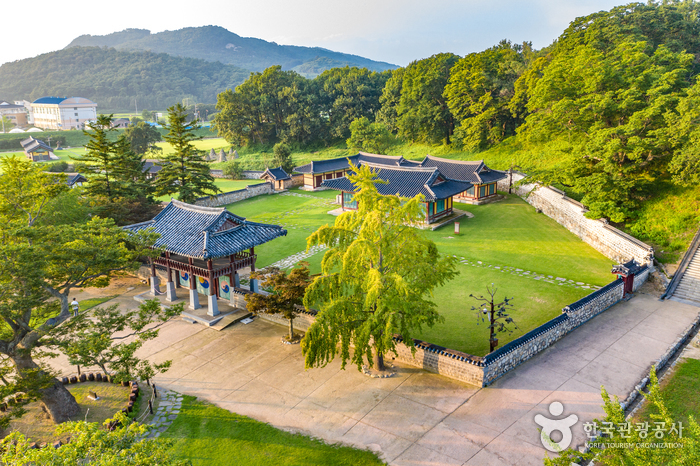
It is a representative eupseong (walled town) from the Joseon Dynasty. Eupseong are flatland castles built around an eup (town), with Haemi Eupseong being famous along with Gochang Eupseong and Nagan Eupseong. Haemi Eupseong is a stone fortress completed in 1491, the 22nd year of King Seongjong's reign. It has a circumference of about 1.8 km, a height of 5 m, and a total area of 196,381 m² (about 60,000 pyeong), featuring three gates: east, south, and west. Recently, restoration and purification projects have restored its original appearance and established it as a historic park. It is also famous as a martyrdom site for Catholics during the late Joseon period. During persecutions of Catholics, many believers from various parts of Chungcheong Province were captured, tortured, and killed at Haemi Eupseong, which had a government office. In particular, about 1,000 people were executed here during the 1866 persecution. In the plaza inside the fortress stands the site of a prison where Catholics arrested during the Daewon-gun regency were held, and an old pagoda tree under which they were brutally tortured by hanging. The 300-year-old tree at the prison entrance still bears iron wire marks from where victims’ hair was tied and hung. Just outside the fortress gate on the roadside is the Jari-gae-dol, where believers who resisted torture while hanging from the pagoda tree were beaten to death on stone slabs, making it a pilgrimage site for Catholics. Quince trees were once planted around the fortress walls to repel enemy troops, but now they are hardly seen.
コース後に休みやすい宿を集めました
会員登録して自分のチャンネルも一緒に紹介してもらう
(会員になると、マイページで設定した Instagram・YouTube・ブログのリンクが、あなたのコメントと一緒に表示されます。)
“「弘大近くに滞在して、夜のカフェ巡りをしました。街の夜景も雰囲気も最高でした。」”
ゲストとして投稿したコメントには、SNSリンクやプロフィールカードは表示されません。
この場所についてのちょっとしたコツや感想をシェアしてください。
ゲストとして、気軽にひとことコメントを残すこともできます。
写真の添付はログイン後に利用できます。
まだレビューがありません。最初の感想を投稿してみましょう!