
海松の森で楽しむキャンプ旅行 in 忠清南道 西川郡 · schedule その他 · distance 52.6km · 6 stops · highlights Hongwon Port, Seosan Hoegwan, 서천 마량리 동백나무 숲
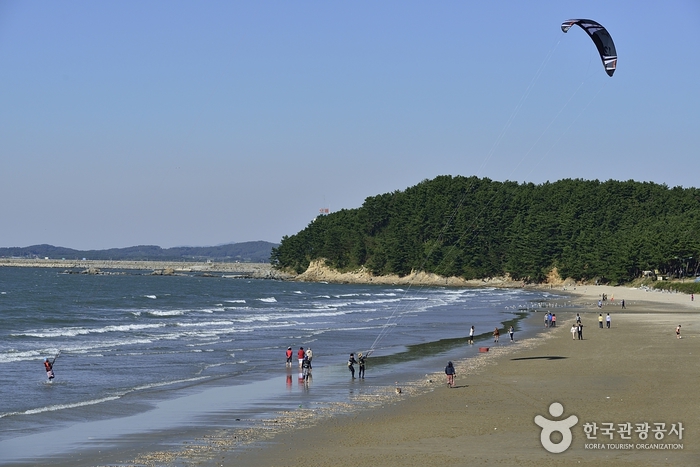
山全体が海松に囲まれており、フィトンチッドの香りに包まれる希理山でキャンプを楽しめる。希理山自然休養林は国内の自然休養林の中で唯一オートキャンプが可能で、キャンプ愛好者に人気がある。東海の海のように青い水色を誇る春長台海水浴場と馬良里ツバキの森も一緒に訪れることが推奨される。
このコースは2日間の旅程サンプルです。そのまま保存するか、AI日程に拡張できます。
Hongwon Port is located on the way to Chunjangdae Beach and is a beautiful place with a breakwater extending into the sea and a white and red lighthouse where you can enjoy sea fishing and natural sashimi. Although smaller in scale compared to famous ports, among the West Sea coast ports it has a notably small tidal range, so many fishing boats come and go. What makes Hongwon Port most famous is the autumn gizzard shad. Called 'jeoneo' because it is believed to eat money, this fish has been mentioned in historical records with the phrase, "In the head of autumn jeoneo, there is a bowl of sesame seeds," and it is highly regarded on the West Sea coast with sayings like "Even a daughter-in-law who left home returns when she smells grilled jeoneo." Although jeoneo is available year-round, its taste is said to be best from late September to early November. Hongwon Port, along with Gwangyang Port in Jeollanam-do, is one of the places with the largest jeoneo catches. Every year from late September for two weeks, the 'Jeoneo Festival' is held at Hongwon Port.
Contrary to its name, Seosan Hoegwan is located in Seocheon and is a specialty restaurant for jjukkumi (small octopus). It is situated right in front of the tidal flat of Seocheon Maryang Port, where jjukkumi is caught alive using conch shells, making it fresh and well-known for its taste. The restaurant serves jjukkumi in stir-fried iron plate and shabu-shabu styles, with the season running from around February to early May. In addition, they offer seafood dishes such as rockfish soup and flower crab soup along with various other menus, with stir-fried jjukkumi on an iron plate being the main representative dish. Nearby attractions include Dongbaekjeong above Maryang Port, Seocheon Marine Glamping, and Chunjangdae Beach, making it a good area to combine sightseeing with dining.
서천 팔경 중의 한 곳인 서면 마랑리 동백나무 숲은 천연기념물 제169호로 지정되어 있다. 이곳에는 5백여 년 수령의 동백나무 85주가 8,265㎡에 울창한 숲을 이루고 있다. 동백나무 숲에 가면 3월 하순부터 5월 초순까지 푸른 잎 사이에 수줍은 듯 피어있는 붉은 동백꽃을 마음껏 감상할 수 있으며, 정상에 있는 동백정에 올라가면 서해의 푸른 바다와 낙조의 아름다움을 한눈에 볼 수 있다.
Opened in 1998, this natural forest of seaside pines covers the entire mountain, offering scenic views. There is a reservoir at the entrance, allowing for forest recreation. Hiking trails lead to the summit, where visitors can overlook the West Sea. Nearby attractions include Chunjangdae Beach, Geumgang Estuary Bank, and Hansan Mosi Town, allowing for combined trips. The recreation forest features educational facilities such as an exhibition hall explaining the forest's public functions and future forestry, a wildflower observation garden displaying wildflowers from Daejeon and Chungcheongnam-do along the entrance road, a mushroom cultivation site growing shiitake and reishi mushrooms, and a hibiscus garden exhibiting different varieties. There are also forest houses made from timber of oak, larch, cedar, seaside pine, Japanese cheesewood, Korean pine, and pine. Additionally, a forest training center accommodating 50 to 60 adults is operated. Sports facilities include a jokgu court and a basketball court.
The Seongbuk-ri Five-story Stone Pagoda, standing 6.2 meters tall, was built during the Goryeo period but reflects Baekje-style characteristics reminiscent of the Five-story Stone Pagoda of Jeongnimsa Temple Site in Buyeo, preserving the distinctive traits of the Baekje territory in the Seocheon area. This pagoda faithfully follows the Baekje stone pagoda style, featuring a single-story pedestal topped by five stories of the pagoda body. Notably, each face tapers upward in a trapezoidal shape—narrow at the top and wide at the base—clearly representing a Baekje pagoda. Therefore, it holds significant value as a national heritage site, playing an important role in tracing the distribution and diffusion routes of Baekje-style pagodas. In 1963, its value was formally recognized with designation as a treasure. The area also offers good opportunities for combined tourism with nearby sites such as Biin Eupseong Fortress, Biin Hyanggyo, Biin Beach, and Wolmyeongsan Mountain.
The Seocheon area lies on the west coast at the end of the Geum River, featuring widely developed tidal flats. Among them, Wolhaseong Village near Biin Beach is shaped like a bay with shallow waters, allowing well-developed tidal flats suitable for hands-on tidal flat experiences. Wolhaseong means 'castle under the moonlight,' reflecting the beautiful moonlight here. At low tide, nearly 1 km of tidal flat is exposed. The flat is sandy rather than muddy, making movement easy. From spring to autumn, visitors can enter the tidal flats to collect various shellfish such as clams, Manila clams, and razor clams, and observe the tidal flat ecosystem. In August, the Wolhaseong Torch Culture Festival is held, using the beautiful natural environment. Experience programs include boat launching culture, fisherman experiences, bare-hand fishing, and crab catching. Nearby attractions such as Biin Beach, Chunjangdae Beach, Dongbaekjeong, Seocheon Maryang-ri Camellia Forest, and Hongwon Port make this area ideal for combined tourism.
コース後に休みやすい宿を集めました
会員登録して自分のチャンネルも一緒に紹介してもらう
(会員になると、マイページで設定した Instagram・YouTube・ブログのリンクが、あなたのコメントと一緒に表示されます。)
“「弘大近くに滞在して、夜のカフェ巡りをしました。街の夜景も雰囲気も最高でした。」”
ゲストとして投稿したコメントには、SNSリンクやプロフィールカードは表示されません。
この場所についてのちょっとしたコツや感想をシェアしてください。
ゲストとして、気軽にひとことコメントを残すこともできます。
写真の添付はログイン後に利用できます。
まだレビューがありません。最初の感想を投稿してみましょう!


