
鉄原、心身の平和、温泉ヒーリング旅行 in 江原特別自治道 チョルウォン郡 · schedule その他 · distance 17.4km · 3 stops · highlights Goseokjeong National Tourist Site, Dopiansa Temple, Cheorw…
毎年晩秋になると、鉄原の温泉をテーマにした温泉祭りが高石亭国民観光地とハンタンリバースパホテル周辺で開催される。家族旅行先として四季を通じて愛される高石亭国民観光地は、自動車キャンプ場やキャラバン、生態池などの施設を備えており、家族のヒーリング休養地として知られている。労働党事務所は朝鮮戦争の痕跡がそのまま残る近代文化遺産で、現在はミュージックビデオの撮影や音楽会の会場としても利用される文化的価値と歴史的建築物として親しまれている。
このコースは1日旅程のサンプルです。そのまま保存するか、AI日程に拡張できます。
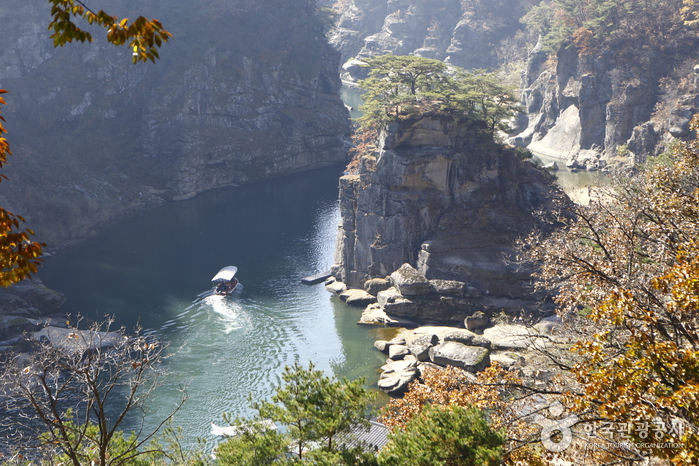
Goseokjeong is one of the nine scenic spots of Cheorwon and the most famous attraction in the area. Towering about 10 meters high in the middle of the Hantan River, a crystal-clear stream flows swirling between the two imposing rock formations. It is said that during the reign of King Jinpyeong of Silla, a two-story pavilion about 10 pyeong in size was built on the middle course of the Hantan River and named Goseokjeong. The pavilion and the valley around Goseok Rock together are called Goseokjeong. Designated as a local monument, it is said that King Jinpyeong of Silla and King Chungsuk of Goryeo visited and enjoyed this place. Goseokjeong became more famous as it was known as the base of Im Geokjeong during the Joseon Dynasty in the era of King Myeongjong. Cheorwon, formed by basalt lava flows in the Quaternary of the Cenozoic era, has the Hantan River flowing from north-northeast to south-southwest, creating columnar joints and vertical cliffs of granite through erosion. Located at the center of the Chugaryeong structural belt and later the passage of the Gyeongwon Line, Cheorwon was a suitable place for Im Geokjeong to hide, as he built a high stone wall opposite Goseokjeong as a mountain fortress base. He resisted the corrupt social class by intercepting tributes passing through this area to the royal court from Hamgyeong-do and aiding the poor. The pavilion was destroyed during the Korean War but was rebuilt in 1971 with local support as a 10-pyeong two-story structure; it was washed away by floods in 1996 and reconstructed again in 1997. Currently, a natural stone chamber where Im Geokjeong hid can be found in the massive 20-meter-high rock in the middle of the river, and a stone fortress remains on the opposite side. This scenic spot remains a national tourist site of Cheorwon’s nine views, attracting visitors year-round. About 2 km upstream are Jiktang Waterfall and about 2 km downstream is Sundam, with wide lawns and multipurpose sports grounds available, making it a favored destination throughout the seasons.
Dopiansa Temple in Cheorwon is a temple located in Dongsong-eup, Cheorwon-gun, Gangwon-do, founded in the 5th year of King Gyeongmun of the Unified Silla period (865). Inside the temple, there is the oldest iron sitting Birojanabul (Iron Buddha) statue made by Doseon Guksa in Korea, which is a national treasure, and a three-story stone pagoda made of granite, designated as a treasure, standing 4.1 meters tall. According to legend, Doseon Guksa created the 91cm iron sitting Birojanabul and, while traveling with several monks to enshrine it at Anyangsa Temple in Cheorwon-eup, the statue mysteriously disappeared during a short rest. After searching the area, they found it at the current location. A small hermitage was built at the site to enshrine the Buddha image, and the temple was named Dopiansa, meaning the Buddha reached an eternal resting place, Pian. Doseon regarded this temple as one of the Bibogukchal (temples that protect the nation), and because Mt. Hwage was shaped like a lotus floating on water, the stone pagoda and iron Buddha were installed to compensate for the mountain's weak points, thereby strengthening the nation's stability and defense against foreign invasions. The three-story stone pagoda was built at the temple's founding, with patterns engraved on each side of the body and a lotus bud-shaped ornament on top. This pagoda was designated as Treasure No. 112 in 1963. Other Buddhist-related buildings on the temple grounds include Daejeokgwangjeon, housing the iron Birojanabul statue; Jongnugak, where the temple bell was hung; and Cheonbuljeon, containing one thousand small Buddha statues. Previously restricted as a civilian control area, the temple is now open to the public without limitation.
The Workers' Party Headquarters located in Gwanjeon-ri, Cheorwon-eup, Gangwon Province, is a three-story building completed in 1946. Until the outbreak of the Korean War, it was used as the Workers' Party Headquarters of North Korea. Currently, the entire building is blackened and densely marked with shell and bullet holes due to extensive damage during the Korean War. However, this appearance reminds visitors of the Korean War and the reality of Korea's division, leading to its use as a filming location for famous singers' music videos and as a venue for well-known concerts. Presently, the Cheorwon Workers' Party Headquarters is operated as a security tourism course by Cheorwon-gun and attracts many tourists. It has been under government protection since being registered as a modern cultural heritage in February 2001.
コース後に休みやすい宿を集めました
会員登録して自分のチャンネルも一緒に紹介してもらう
(会員になると、マイページで設定した Instagram・YouTube・ブログのリンクが、あなたのコメントと一緒に表示されます。)
“「弘大近くに滞在して、夜のカフェ巡りをしました。街の夜景も雰囲気も最高でした。」”
ゲストとして投稿したコメントには、SNSリンクやプロフィールカードは表示されません。
この場所についてのちょっとしたコツや感想をシェアしてください。
ゲストとして、気軽にひとことコメントを残すこともできます。
写真の添付はログイン後に利用できます。
まだレビューがありません。最初の感想を投稿してみましょう!


